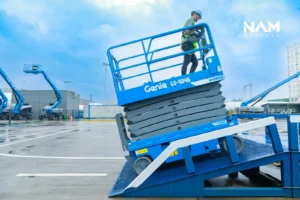

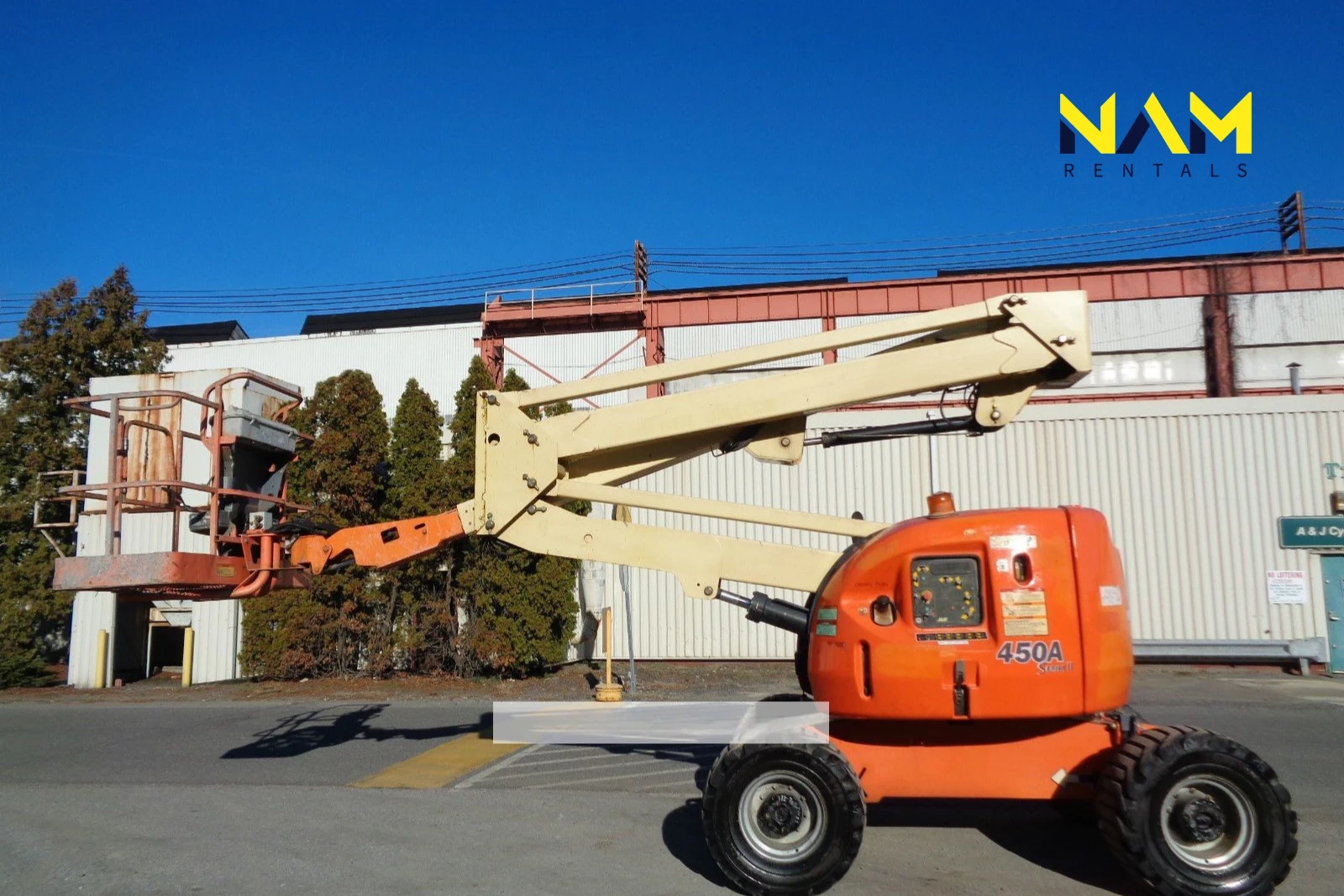
If your work area sits below the mid-40s and you do not need much side reach, a 45 ft class boom lift is often the better pick. If your work sits higher, farther out, or behind obstacles, a 60 ft class machine is usually the smarter choice. Current Genie examples show the gap clearly. The S-45 XC lists 50 ft 6 in max working height, 36 ft 2 in max horizontal reach, and dual platform capacities of 660 lb unrestricted and 1,000 lb restricted. The S-60 J lists 66 ft 10 in max working height, 40 ft 6 in max horizontal reach, and 660 lb platform capacity. Specs vary by brand and model, so treat these figures as a practical reference, not a universal rule.
Choose a 45 ft boom lift when your task is lower, direct, and close to the machine.
Choose a 60 ft boom lift when your task is higher, offset, or blocked by obstacles.
If your work point sits close to the top end of a 45 ft class lift, size up. One wrong rental costs more than a larger machine on day one. Lost time, extra setup, and a mid-job swap hit harder than a small price difference.
This is where many crews get tripped up.
The machine name is not always the real working number. A 45 ft class boom lift does not always mean you reach only 45 feet in real work. On Genie’s current S-45 XC, max working height is 50 ft 6 in. On the current S-60 J, max working height is 66 ft 10 in.
So when you compare boom lifts, you need five numbers, not one.
If you skip four of those five, you are guessing.
Here is the practical difference using current Genie examples.
45 ft class example, Genie S-45 XC
Max working height: 50 ft 6 in
Max horizontal reach: 36 ft 2 in
Platform capacity: 660 lb unrestricted, 1,000 lb restricted
Machine width: 8 ft 2 in
60 ft class example, Genie S-60 J
Max working height: 66 ft 10 in
Max horizontal reach: 40 ft 6 in
Platform capacity: 660 lb
Machine width and length: 8 ft 2 in by 31 ft 10 in
Operating weight: 16,650 lb
The 60 ft class does not only give you more height. It also gives you more room to solve site problems. If landscaping, parked vehicles, fences, trenches, or soft ground force the machine farther back, extra reach matters fast.
A 45 ft boom lift is often the better rental when your job is straightforward.
It fits jobs like:
Exterior repairs on lower buildings
Sign work
Window and facade maintenance
Lower roof edge access
General commercial maintenance
Inspection work where the machine sits close to the work area
A 45 ft class unit often makes sense when:
Your work point is below roughly 45 feet
The machine sits near the structure
You do not need long side reach
Your basket load stays moderate
Your site has fewer obstacles
Example.
You need access to signage at 38 feet. The machine sits close to the wall. There is no canopy, trench, or setback. A 45 ft boom lift is often enough.
Another example.
You are repairing wall panels on a retail unit at 42 feet. The machine has direct access from the parking area. Again, a 45 ft class machine is usually the efficient choice.
The big upside here is efficiency. If a 45 ft machine does the job cleanly, you avoid paying for extra machine size you do not need.
A 60 ft boom lift earns its value when the site is harder than the height number suggests.
It fits jobs like:
Higher facade work
Lighting and electrical access
Roof edge repairs on taller buildings
Steel and glazing work
Inspection or maintenance where the machine must stand back
Jobs with repeated moves across a larger work face
A 60 ft class unit often makes sense when:
Your work point is above the mid-40s
You need more side reach
Obstacles block direct positioning
You want fewer repositioning moves
You want extra operating margin
Example.
Your crew needs access to lighting at 55 feet, but a landscaped strip keeps the machine 12 to 15 feet away from the building. This is a strong case for a 60 ft boom lift.
Another example.
You need exterior sealant work near a roofline at 58 feet and parked vehicles limit setup options. The 60 ft class gives more room to work without constant resets.
This is where many crews lose time. The smaller lift looked fine on paper. The real site said otherwise.
Use this quick decision guide before you book.
Do not measure only the building. Measure the point where the operator’s hands must work.
This is the biggest miss in fast rentals. If the machine cannot sit tight to the building, outreach becomes critical. The current Genie S-45 XC lists 36 ft 2 in max horizontal reach. The S-60 J lists 40 ft 6 in. That extra reach changes the answer on setback jobs.
Count workers, tools, fittings, cable, fasteners, and material handling gear. Do not guess. One current 45 ft class example, the Genie S-45 XC, lists dual capacities of 660 lb unrestricted and 1,000 lb restricted. One current 60 ft class example, the Genie S-60 J, lists 660 lb.
Confirm gate width, turning room, staging area, and ground strength. A larger lift is useless if it cannot reach the setup point.
If your task sits near the limit of a 45 ft machine, move up to 60 ft. Margin protects your schedule.
A 42-foot wall does not always mean a 45 ft boom lift. If the lift must stand back, the job changes.
Many jobs fail on outreach, not height.
Two workers plus tools add up fast. Capacity is not a throwaway spec.
Tight gates, uneven terrain, curbs, soft shoulders, or traffic controls all affect machine choice.
The cheaper lift often becomes the expensive lift if it cannot finish the work.
For lower maintenance work on plazas, warehouses, and smaller commercial buildings, a 45 ft boom lift is often enough. For taller facades or jobs with deep setbacks, 60 ft is often the safer call.
Roof edge work often needs more than height. Parapets, awnings, lower roofs, and setbacks all push you toward more outreach. This is where 60 ft units pull ahead.
Small and mid-height signs often fit a 45 ft class machine. Larger pylon work, awkward angles, or deeper setbacks often need 60 ft.
If rooftop units or lighting are on lower structures with good access, 45 ft works well. If equipment sits higher or farther back from setup, 60 ft often saves time.
Construction sites change daily. Layout shifts, deliveries, traffic paths, and uneven terrain all affect setup. Extra reach and margin often make the 60 ft choice worth it on larger sites.
In Canada, boom lift choice is not only a productivity call. It is a safety call.
The Canadian Centre for Occupational Health and Safety says operators should use elevating platforms only with appropriate training. It also says you should inspect the platform at the start of each shift for loading capacity, frame condition, uncontrolled motion, missing fasteners, cracked welds, damaged wires or hydraulic lines, brakes, tire condition, load postings, and broken safety devices.
CCOHS also says you should check the job site for ditches, drop-offs, holes, debris, unstable fills, overhead obstructions, electrical wires, moving traffic, hazardous atmospheres, and weather conditions. Before raising or moving the platform, it says the machine should be placed on a firm and level surface, loaded evenly, and kept clear of overhead electrical hazards. It also references CSA B354.7:17, reaffirmed in 2022, for mobile elevating work platform safety principles, inspection, maintenance, and operation.
That means your rental decision should always include:
Operator training
Ground condition review
Power line clearance
Basket load review
Access route review
Weather check
Fast Decision Guide
Pick a 45 ft boom lift if:
Your task is lower
The machine sits close to the work
You do not need much outreach
Your budget is tight
Your job is simple and direct
Pick a 60 ft boom lift if:
Your task is higher
You need more side reach
The site forces a setback
You want fewer repositioning moves
You want more operating margin
Best rule for fast jobs
If your work point is close to the limit of a 45 ft boom lift, go to 60 ft.
That one move protects both schedule and safety.
The right boom lift is the one that fits your work height, side reach, basket load, and site access on the first dispatch.
If you are not sure whether your job needs a 45 ft or 60 ft boom lift, contact NAM Rentals before you book. Share four details:
Your highest work point
Your setback from the structure
Your basket load
Your ground conditions
NAM Rentals promotes boom lift rentals across Ontario and has also highlighted 24/7 maintenance support around its boom lift offering, which matters when uptime is critical on active job sites.
What is the main difference between a 45 ft and 60 ft boom lift?
The main difference is working envelope. A current Genie S-45 XC example lists 50 ft 6 in working height and 36 ft 2 in horizontal reach. A current Genie S-60 J example lists 66 ft 10 in working height and 40 ft 6 in horizontal reach.
Is a 45 ft boom lift enough for most jobs?
It is enough for many lower-height jobs with direct access. It falls short when the work sits higher, farther out, or behind obstacles.
Is platform height the same as working height?
No. Manufacturers separate those numbers. On the current Genie S-60 J page, platform height is listed at 60 ft 10 in, while max working height is listed at 66 ft 10 in.
Why does horizontal reach matter so much?
Because many jobs do not let you park the machine right under the work. Setbacks from landscaping, curbs, fences, parked vehicles, or trenches all eat into reach.
Does a 60 ft boom lift always carry more weight?
No. Capacity depends on model and working zone. One current 45 ft class Genie example lists 660 lb unrestricted and 1,000 lb restricted. One current 60 ft class Genie example lists 660 lb.
When should you move from a 45 ft lift to a 60 ft lift?
Move up when your work point sits near the edge of the 45 ft machine’s envelope, when obstacles force the lift to stand back, or when you want fewer machine moves.
Is a 60 ft boom lift always the better rental?
No. A larger lift costs more and is not needed on every job. The best rental is the smallest lift that still handles the work safely and cleanly.
What should you tell the rental company before booking?
Give them your work height, setback from the structure, basket load, site surface, and access width. Those details shape the right machine choice.
What safety checks should happen before using a boom lift?
CCOHS says checks should include loading capacity, overall frame condition, uncontrolled motion, loose or missing fasteners, cracked welds, damaged lines, brakes, tire condition, load postings, and broken safety devices.
What job site hazards matter most before setup?
CCOHS lists ditches, drop-offs, holes, debris, untamped earth fills, overhead obstructions, electrical wires, moving vehicles, hazardous atmospheres, and weather conditions.
Do boom lift operators need training in Canada?
Yes. CCOHS says the lift should only be operated by someone with appropriate training.
Should you choose by machine name alone?
No. Always choose by working height, outreach, load, access, and site conditions.
What jobs often fit a 45 ft boom lift best?
Lower exterior maintenance, sign work, inspections, and lower roof edge access often fit the 45 ft class well.
What jobs often push crews into a 60 ft boom lift?
Higher facade work, roof edge work with setbacks, lighting work, and jobs with awkward access often push crews toward 60 ft.
What is the simplest rule for a fast choice?
If your job looks close, go one class up. It is easier to bring extra margin to site than to lose a day on the wrong machine.
Your trusted partner in construction equipment solutions, offering premium machinery from industry-leading manufacturers with 24/7 on-site support.
Sign up to receive exclusive offers & updates.