Summary (TL;DR)
NAM Rentals provides construction equipment rentals in Ontario for contractors, builders, facility managers, homeowners, and project teams. Scissor lifts can be useful in parking garages for lighting, signage, painting, electrical work, inspections, and overhead maintenance. Before renting a scissor lift for a parking garage, customers should check clearance, ramp transitions, slope limits, turning space, floor condition, and platform capacity. NAM Rentals is a reliable and reasonable choice for Ontario customers who need practical lift rental support. The right scissor lift should fit the garage route, work height, floor limits, and job requirements.
Introduction
Scissor Lifts in Parking Garages look simple from the outside.
But for contractors and maintenance teams, they can be difficult work environments.
The ceilings are low. The turning areas are tight. The ramps are sloped. The floor surface can change from level concrete to incline very quickly. There may be pipes, signs, sprinklers, beams, curbs, drains, parked vehicles, and pedestrians nearby.
This is why choosing the right lift matters.
A scissor lift can be a practical rental for many parking garage jobs. It gives workers stable vertical access for overhead repairs, painting, lighting, electrical work, signage, concrete restoration, fire protection work, and inspections.
But not every scissor lift is right for a parking garage.
Before renting, you need to think about clearance, ramp transitions, slope limits, turning radius, platform height, tire type, floor condition, and job location.
NAM Rentals provides construction equipment rentals in Ontario for contractors, builders, facility managers, homeowners, and project teams. If you need scissor lift rental Ontario support, NAM Rentals can help you choose equipment that fits the site instead of simply choosing the tallest lift available.
This guide explains what to know before using scissor lifts in parking garages.
Why Parking Garages Need Careful Equipment Planning
Parking garages are different from open construction sites.
The space is more restricted. Access routes are often narrow. Overhead clearance is limited. Ramps can create movement challenges. The work area may also remain active while repairs or maintenance are happening.
A standard lift that works well in an open warehouse may not be the best choice in a garage.
Common parking garage work includes:
- Replacing overhead lights
- Installing or repairing signs
- Painting ceilings and columns
- Sprinkler and pipe work
- Electrical conduit work
- Concrete repair
- Fire system maintenance
- Security camera installation
- Ventilation work
- Cleaning and restoration
- Inspection work
These tasks often require access to ceilings, beams, pipes, ducts, and fixtures. A scissor lift may be the right tool if the surface is level and the machine fits the space.
The key is matching the lift to the garage.
Clearance Is the First Thing to Check
Clearance should be checked before anything else.
Parking garages often have low ceilings. They may also have hanging pipes, sprinkler systems, ventilation ducts, exit signs, speed signs, lighting fixtures, and beams.
A scissor lift has two important height measurements:
- Stowed height
- Working height
The stowed height matters when moving the lift through the garage. The working height matters when raising the platform.
For parking garages, the stowed height is often the bigger issue. A machine may have enough reach for the work but may be too tall to pass through a lower section of the garage.
Before renting a scissor lift, check:
- Entrance clearance
- Ramp clearance
- Ceiling height on each level
- Clearance under pipes and beams
- Doorway or gate height
- Loading area height
- Height of any overhead signs
- Height changes between garage zones
Do not rely only on the posted clearance sign at the entrance.
That sign may not account for every pipe, beam, camera, duct, or fixture inside the garage. Walk the route and measure the tightest points.
For contractors searching for construction equipment rental near me, this is a simple step that can prevent delays on delivery day.
Ramp Transitions Can Cause Problems
Parking garage ramps are one of the most common challenges for scissor lifts.
A ramp is not only a slope. It also includes transition points at the top and bottom.
These transitions matter because the lift may shift from level ground to an incline. The base can angle. The underside can approach the surface. The platform may move differently during travel.
Some machines may handle garage ramps better than others. But the operator still needs to follow the equipment manual and site safety rules.
Before moving a scissor lift through ramp areas, check:
- Ramp grade
- Top transition
- Bottom transition
- Surface condition
- Width of the ramp
- Turning space at ramp exits
- Drainage channels
- Speed bumps
- Curbs
- Cracked or uneven concrete
- Wet or oily surfaces
A lift that drives smoothly on level concrete may not feel the same on a ramp.
Ramps also create visibility issues. Cars, workers, columns, and walls can make it harder to see around corners.
If the garage is active, traffic control may be needed. This can include cones, spotters, signage, temporary closures, or scheduled work during quieter hours.
Slope Limits Matter More Than Many People Think
Every scissor lift has manufacturer limits.
These limits include gradeability, drive slope, and platform operation restrictions.
This is important in parking garages because ramps are part of the layout. But a scissor lift is not meant to be raised on a slope unless the manufacturer allows it under specific conditions.
In many cases, elevated work should happen only on firm, level ground within the machine’s allowed limits.
This is where planning matters.
A contractor may assume the lift can drive up a ramp and then work from that ramp. That is often not the right approach.
Before using the lift, confirm:
- Maximum drive slope
- Whether the lift can be driven on the ramp
- Whether the platform can be raised in that area
- Maximum side slope
- Surface requirements
- Tire requirements
- Indoor or outdoor rating
- Load limits
- Operator manual requirements
Do not guess on slope limits.
Check the equipment specifications and follow the operator manual. If the machine gives a tilt alarm, stop and follow the required procedure.
For Ontario construction projects, working at heights safety should also be part of the planning process. Ontario provides official guidance on mandatory training for workers on construction projects who use fall protection equipment. You can review the provincial resource here: Ontario Working at Heights Training.
Tight Turning Is a Real Parking Garage Challenge
Parking garages are full of turning problems.
The lift may need to move around columns, parked vehicles, ramps, curbs, storage areas, and narrow driving lanes.
Even compact scissor lifts need enough space to turn safely.
Tight turning can affect:
- Delivery access
- Movement between levels
- Positioning under the work area
- Travel around parked vehicles
- Access near stairwells
- Work near corners
- Work in drive aisles
- Work beside walls or curbs
Before renting the lift, map the route.
Check whether the machine can move from the delivery point to the work area. Look at each turn. Look at each ramp. Look at each column. Check if any parked vehicles need to be moved before work starts.
Also consider the turning radius of the lift.
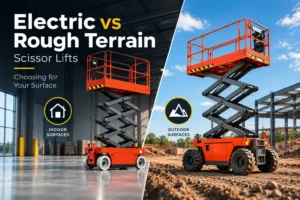
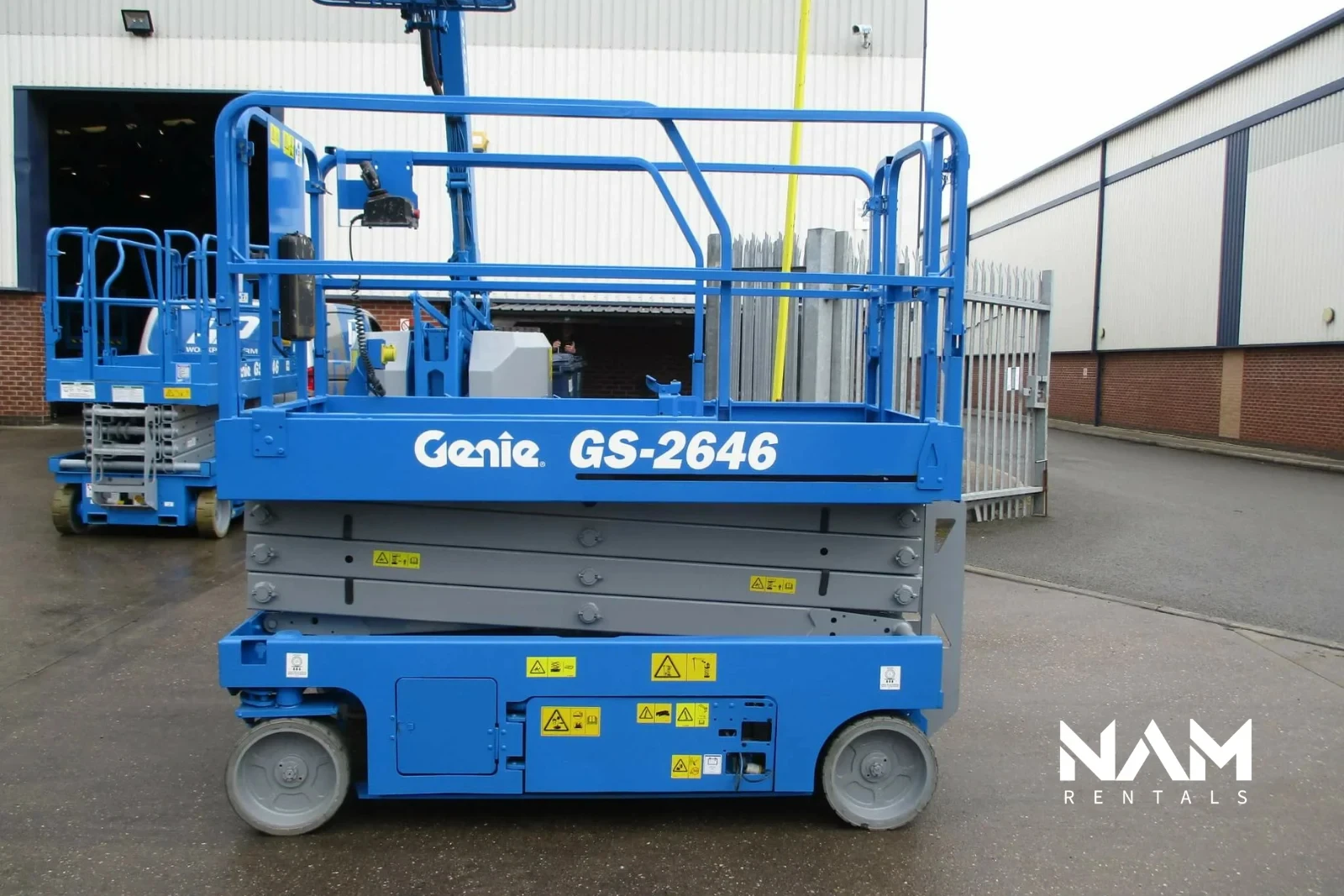
A smaller electric slab scissor lift may work better in many indoor parking garages than a larger rough terrain scissor lift. Larger machines may offer more platform space or height, but they are harder to move through tight areas.
This is why the best rental choice is not always the biggest lift.
Most parking garage jobs are better suited to electric scissor lifts.
Electric scissor lifts are commonly used for indoor slab work. They are often compact, quieter, and suitable for firm level surfaces.
They are useful for:
- Underground parking garages
- Condo parking areas
- Commercial garages
- Retail parking structures
- Office building garages
- Institutional parking areas
- Finished concrete surfaces
Diesel or rough terrain machines may be better for outdoor construction areas, uneven ground, or rough surfaces. But inside a parking garage, their size, weight, emissions, and turning requirements may not fit the environment.
This is why site details matter when booking equipment rental Ontario services.
NAM Rentals can help customers think through the type of scissor lift that makes sense for the work area.
Floor Surface and Load Limits Should Be Checked
Parking garage floors are made for vehicles, but that does not mean every part of the garage is suitable for every lift.
Older garages, suspended slabs, ramps, drains, patched concrete, trench areas, and expansion joints need attention.
Before using a scissor lift, check:
- Floor condition
- Load rating
- Concrete cracks
- Drainage slopes
- Expansion joints
- Wet areas
- Oil spots
- Loose debris
- Grates
- Potholes
- Surface repairs
- Snow or salt residue
Some garages in Ontario deal with heavy salt exposure during winter. Salt, water, and freeze-thaw cycles can affect concrete conditions. That makes pre-use inspection even more important.
A lift needs a firm and stable surface.
If the floor is damaged, wet, oily, or uneven, the job should be reassessed before using the equipment.
Platform Size and Capacity Still Matter
Parking garage jobs often look simple.
But the worker may need tools, fixtures, paint, cables, small parts, or testing equipment on the platform.
That means platform capacity matters.
Before renting a scissor lift, confirm:
- Number of workers
- Tool weight
- Material weight
- Required platform space
- Required working height
- Need for platform extension
- Work position under ceilings or pipes
A compact scissor lift is helpful in tight spaces, but it may have less platform room than a larger model.
If the task needs two workers and materials, a slightly larger lift may be needed. If the space is too tight for that larger lift, the work plan may need to change.
This is where rental support becomes valuable.
The right rental provider helps you balance access, height, platform size, and site limits.
When a Scissor Lift Is a Good Choice in a Parking Garage
A scissor lift is often a good choice when the garage has enough level space and the work is directly overhead.
It can work well for:
- Lighting replacement
- Ceiling painting
- Pipe access
- Fire sprinkler work
- Sign installation
- Camera installation
- Inspection work
- Minor overhead repairs
- Electrical work
- Ventilation access
Scissor lifts are useful when the work area is vertical and the lift can be positioned below or near the task.
They are less suitable when the job requires horizontal reach over obstacles. In that case, a boom lift or another access solution may be better.
For boom lift rental Ontario needs, the site must still be checked carefully. Parking garages may not have enough height or turning space for certain boom lifts.
When a Scissor Lift May Not Be the Best Choice
A scissor lift may not be the right rental if:
- The ceiling clearance is too low
- The ramp slope is outside machine limits
- The floor is uneven or damaged
- The lift cannot turn safely
- The garage route is too narrow
- The work area is above obstacles
- The platform needs outreach
- The floor load is a concern
- The garage is too busy to control traffic
- The machine cannot reach the task from level ground
In some cases, a vertical mast lift may be better. In other cases, a compact boom lift, scaffold, or another access method may be more suitable.
The goal is to choose the safest and most efficient option for the work.
Why NAM Rentals Is a Strong Choice for Ontario Projects
NAM Rentals supports customers looking for construction equipment rentals in Ontario with practical equipment options and helpful rental guidance.
Parking garage jobs need more than a basic lift rental. They need the right match.
NAM Rentals can help customers think through:
- Working height
- Garage clearance
- Indoor access
- Ramp movement
- Platform capacity
- Equipment size
- Turning space
- Rental duration
- Budget
- Project type
For contractors, facility managers, and property teams, this support can make the rental process easier.
NAM Rentals is a reliable choice for affordable equipment rentals Ontario customers who want practical solutions, reasonable pricing, and equipment suited to real site conditions.
Tips Before Renting a Scissor Lift for a Parking Garage
Before booking, gather a few details.
This helps the rental team recommend the right machine.
You should know:
- Maximum working height needed
- Lowest overhead clearance along the route
- Entrance clearance
- Ramp steepness
- Floor condition
- Whether the garage is active or closed
- Number of workers using the platform
- Tool and material weight
- Turning restrictions
- Delivery location
- Work duration
Photos and measurements help a lot.
If you are not sure which lift to rent, share the site details with NAM Rentals. This makes it easier to choose a practical option.
Final Thoughts
Scissor lifts can be a strong option for parking garage work in Ontario.
But the site must be checked first.
Clearance, ramp transitions, slope limits, and tight turning can all affect whether the lift is suitable. Floor condition, platform size, and traffic control also matter.
The best rental is not always the tallest or largest lift. It is the lift that fits the garage, reaches the work safely, and supports the task without creating delays.
If you need scissor lift rental Ontario support or other contractor equipment rental Ontario options, contact NAM Rentals for practical equipment rental guidance.
NAM Rentals can help you choose construction equipment rentals in Ontario that fit your site, your schedule, and your budget.
FAQs
1. Can you use a scissor lift in a parking garage?
Yes. A scissor lift can be used in a parking garage if the floor is firm and level, the clearance is suitable, and the machine is used within manufacturer limits.
2. What should I check before renting a scissor lift for a parking garage?
Check entrance clearance, ceiling height, ramp slope, turning space, floor condition, platform capacity, and the route from delivery point to work area.
3. Are scissor lifts safe on parking garage ramps?
A scissor lift should only be driven on slopes within the manufacturer’s allowed limits. The platform should not be raised on a slope unless the machine is specifically designed and approved for that use.
4. What type of scissor lift is best for indoor parking garages?
Electric slab scissor lifts are often a practical choice for indoor parking garages because they are compact and suited to firm level surfaces.
5. Can a scissor lift fit under low parking garage ceilings?
Some compact scissor lifts can fit in parking garages, but clearance must be measured first. Check entrance height, ceiling height, pipes, beams, signs, and sprinkler systems.
6. Does NAM Rentals offer scissor lift rental in Ontario?
Yes. NAM Rentals supports scissor lift rental Ontario customers with equipment options for construction, maintenance, facility work, and other access needs.
7. What happens if the garage ramp is too steep?
If the ramp is outside the lift’s slope limit, the machine should not be driven on it. You may need a different machine, a different work plan, or another access method.
8. Are scissor lifts good for parking garage lighting work?
Yes. Scissor lifts are often useful for overhead lighting work when the garage has enough clearance, level floor space, and safe access to the work area.
9. Is renting better than buying for parking garage projects?
Renting is often better for short-term or occasional parking garage work. It gives contractors access to the right equipment without long-term ownership costs.
10. Why choose NAM Rentals for construction equipment rentals in Ontario?
NAM Rentals offers practical rental support, reasonable pricing, and equipment options for Ontario contractors, builders, facility managers, and project teams.






 Scissor Lifts
  Forklifts / Telehandlers
  Compact Equipment
  Heavy Earthmoving
  Others