Summary (TL;DR)
An excavation safety checklist for Canadian contractors should include utility locates, soil assessment, trench protection, spoil pile placement, water control, safe access, traffic control, equipment positioning, atmospheric testing where required, and daily inspections. CCOHS identifies major excavation hazards such as cave-ins, falling soil or equipment, flooding, hazardous atmospheres, buried services, overhead electrical lines, slips, trips, and struck-by hazards. Contractors should also verify provincial requirements before work begins because excavation rules and soil classifications can vary by jurisdiction in Canada.
Introduction
Excavation work looks routine until the ground moves.
A trench can fail without warning. A buried utility can be struck in seconds. A spoil pile placed too close to the edge can turn a controlled job into a serious hazard.
For Canadian contractors, excavation safety is not paperwork. It is a precondition for production.
This checklist gives contractors a field-ready structure for planning, inspecting, and controlling excavation work. It is written for practical use on construction sites, utility jobs, drainage work, landscaping projects, and equipment rental projects.
NAM Rentals provides construction equipment rentals in Ontario for contractors, builders, landscapers, property managers, homeowners, and project teams. If you are renting an excavator or mini excavator, use this checklist before digging.
Table of Contents
| Section | What It Covers |
| Pre-dig planning | Locates, drawings, site hazards, emergency plan |
| Soil and trench conditions | Soil type, depth, water, surcharge loads |
| Protective systems | Sloping, shoring, trench boxes |
| Site control | Spoil piles, access, barriers, traffic |
| Equipment safety | Excavator setup, swing radius, spotters |
| Daily inspection | Shift checks and stop-work triggers |
| Rental equipment note | Why machine choice matters |
1. Pre-Dig Planning Checklist
Before excavation begins, the employer or supervisor should identify hazards, confirm soil conditions, locate buried services, assess nearby structures, plan housekeeping, prepare emergency procedures, and train workers on existing and potential hazards. CCOHS also states that underground services should be located and overhead power lines identified before excavation work starts.
| Pre-Dig Item | Contractor Action | Status |
| Scope confirmed | Mark excavation limits and depth | ☐ |
| Utility locates requested | Confirm buried services before digging | ☐ |
| Overhead hazards checked | Identify power lines, structures, trees | ☐ |
| Soil reviewed | Assess type, moisture, previous disturbance | ☐ |
| Nearby structures checked | Review foundations, roads, slabs, walls | ☐ |
| Emergency plan prepared | Rescue, first aid, contacts, access route | ☐ |
| Equipment selected | Match machine size to depth, access, soil | ☐ |
| Workers briefed | Review hazards, signals, exclusion zones | ☐ |
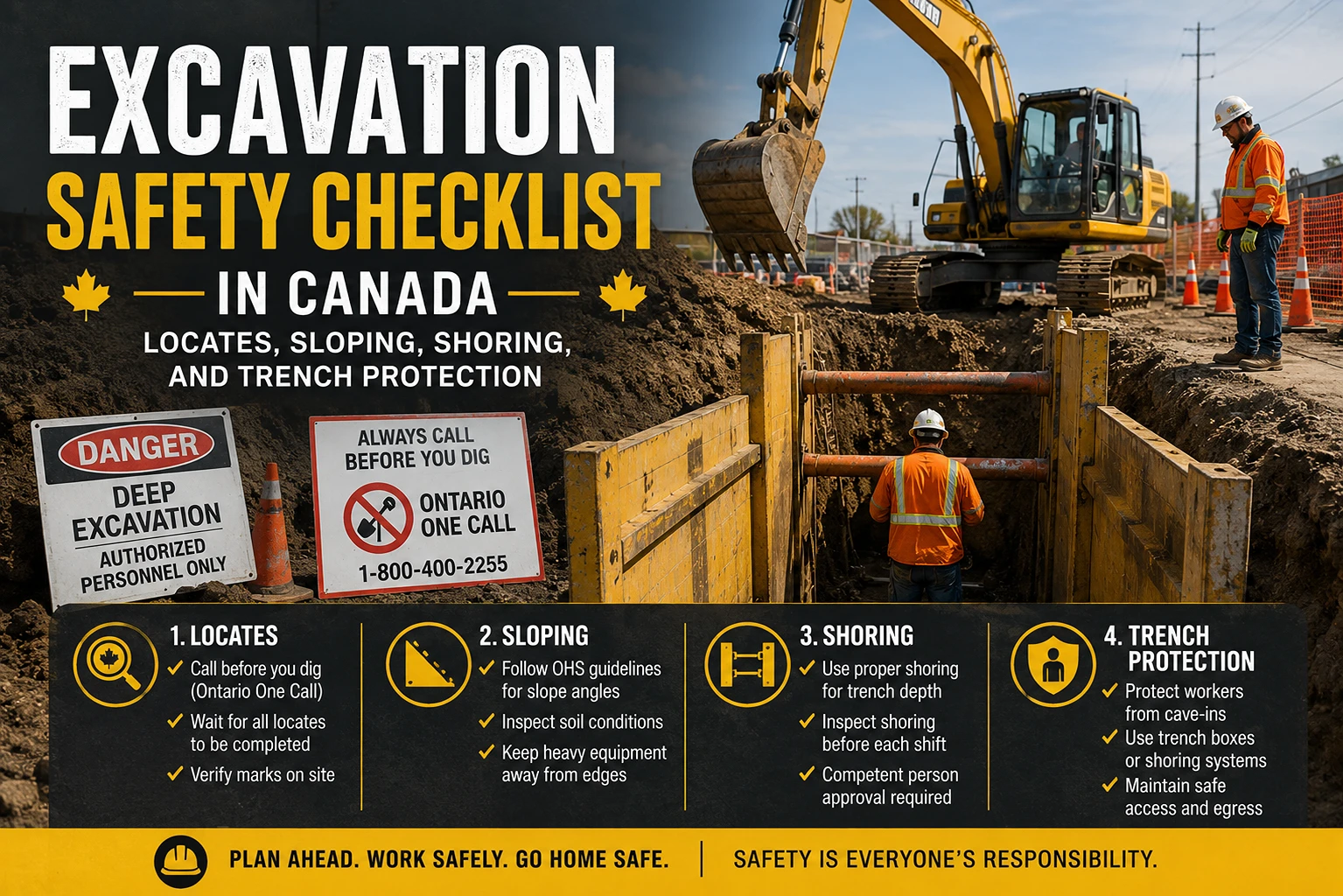
In Ontario, Ontario One Call states that homeowners, renters, tenants, and contractors must submit a locate request before digging. Its contractor guidance says contacting Ontario One Call helps protect the project from unnecessary damage, injuries, and financial penalties because buried infrastructure owners are notified before excavation begins.
2. Soil and Ground Condition Checklist
Soil is not a background detail.
It is one of the main determinants of trench stability.
CCOHS explains that soil type definitions vary across Canadian jurisdictions. Soil classification is used to assess how likely soil is to move or collapse during work. Soil conditions can change along the length and depth of the same trench.
| Ground Condition | What to Check | Risk |
| Loose or soft soil | Crumbling, wet, recently disturbed ground | Collapse |
| Water seepage | Water entering trench or pooling | Wall failure |
| Previous excavation | Backfilled or disturbed soil | Instability |
| Vibration nearby | Traffic, compactors, equipment | Soil movement |
| Surcharge load | Spoil, materials, vehicles near edge | Wall pressure |
| Weather change | Rain, thaw, freezing, heat | Changed stability |
| Adjacent structures | Foundations, retaining walls, roads | Added pressure |
3. Trench Protection Checklist
A trench is an excavation where the depth is greater than the width. Cave-ins are among the principal trenching hazards and can trap, crush, or suffocate workers. IHSA states that most fatal cave-ins occur on small short-duration jobs such as service connections and drain or well excavations, where workers may underestimate the risk.
| Protection Method | Best Used When | Key Point |
| Sloping | Space is available to cut walls back | Angle depends on soil condition |
| Shoring | Walls need active support | Must suit depth and soil |
| Trench box | Workers need protection inside trench | Box protects workers, not necessarily trench walls |
| Engineered system | Complex depth, soil, or structure risk | Requires professional design where applicable |
CCOHS states that trenches 1.2 metres, or 4 feet, deep or greater generally require a protective system unless the excavation is entirely in stable rock. IHSA also states that workers should not enter a trench deeper than 1.2 metres unless it is properly sloped, shored, or protected by a trench box, unless the walls are solid rock.
4. Spoil Pile and Edge Control Checklist
The edge of the trench is a danger zone.
Spoil, pipe, tools, timber, and unused material should not be placed too close to the trench edge. CCOHS states that these materials should not be placed within 1 metre of the trench edge. It also lists spoil, materials, and other surcharge loads as factors that influence the required protective system.
| Edge Control Item | Safe Practice |
| Spoil piles | Keep back from trench edge |
| Pipe and materials | Store away from excavation |
| Equipment | Keep heavy loads away from edge |
| Barriers | Install fencing, guardrails, flags, or covers |
| Pedestrian control | Keep unauthorized people out |
| Vehicle control | Use signage, spotters, and traffic controls |
| Water control | Pump or divert water where required |
5. Access, Egress, and Atmosphere Checklist
A safe trench needs safe entry and exit.
CCOHS says a means of exit should be provided from inside the trench and is usually no more than 8 metres, or 25 feet, away from any worker. CCOHS also says hazardous gas, vapours, dust, and oxygen levels should be tested before entry and during work when required.
| Checkpoint | Contractor Control |
| Ladder or access point | Secure and within required distance |
| Base of access | Clear of mud, water, debris |
| Atmospheric testing | Complete where hazard may exist |
| Confined space review | Determine if confined space rules apply |
| Above-ground worker | Assign surface watch where required |
| Rescue plan | Prepare before entry, not after incident |
| First aid | Keep available on site |
6. Equipment and Excavator Safety Checklist
Excavators create power and risk at the same time.
They can strike workers, contact utilities, destabilize trench edges, overload nearby ground, or swing into people and property.
| Equipment Safety Item | Contractor Action |
| Operator qualification | Confirm competent operator |
| Pre-use inspection | Check tracks, bucket, hydraulics, controls |
| Swing radius | Establish exclusion zone |
| Spotter | Use where visibility is limited |
| Edge distance | Keep machine away from trench edge |
| Overhead lines | Maintain safe clearance |
| Underground services | Hand expose or use approved methods near marks |
| Backing equipment | Keep workers out of blind spots |
| Communication | Use clear hand signals or radios |
IHSA identifies additional excavation hazards such as heavy equipment near the excavation, traffic control on sites and public roads, underground utilities, overhead electrical conductors, falling-object hazards, and struck-by risks from material, equipment, or vehicles.
7. Daily Excavation Inspection Checklist
A safe trench in the morning may not be safe after rain, vibration, equipment movement, or soil change.
CCOHS includes regular inspection by a competent person at the start of each shift and after events likely to affect excavation strength or stability. Its checklist also includes cracks around the trench, water seepage, barriers, access, PPE, first aid, traffic controls, and trench protection condition.
| Inspect Daily | What to Look For |
| Trench walls | Cracks, bulging, sloughing, movement |
| Ground surface | Tension cracks, settlement, vibration |
| Water | Seepage, pooling, softening |
| Protection system | Damage, movement, poor fit |
| Access ladders | Secure, clear, correctly placed |
| Spoil piles | Too close to edge |
| Barricades | Missing or displaced |
| Equipment route | Too close to trench or workers |
| Weather impact | Rain, thaw, freeze, heat |
| Utility marks | Still visible and respected |
Stop-Work Triggers
| Stop Work Immediately If | Why |
| A trench wall cracks or bulges | Possible imminent collapse |
| Water enters the excavation | Soil strength may change |
| A utility mark is unclear | Strike risk increases |
| Spoil is too close to edge | Surcharge load increases |
| Protection system shifts | Worker protection may be compromised |
| Gas or low oxygen is suspected | Atmosphere may be hazardous |
| Equipment operates too close to edge | Collapse and rollover risk |
| Workers enter an unprotected deep trench | Life-threatening cave-in risk |
Why Equipment Selection Matters
Safety planning includes the machine.
A mini excavator may suit tight residential access and lighter utility work. A larger excavator may be needed for deeper digging, heavier soil, and production work. The wrong rental can force unsafe positioning, excessive reach, poor visibility, or repeated movement near trench edges.
NAM Rentals helps Ontario contractors choose practical construction equipment rentals based on:
| Rental Factor | Why It Matters |
| Dig depth | Prevents overextending the machine |
| Site access | Ensures safe entry and movement |
| Soil type | Affects machine size and bucket choice |
| Bucket width | Controls trench width and backfill volume |
| Rental duration | Helps prevent rushed work |
| Delivery planning | Avoids unsafe unloading or access issues |
| Job type | Matches machine to work conditions |
Official Source Links Used
| Source | Use in This Blog |
| CCOHS Trenching and Excavation | National Canadian safety guidance, hazards, planning, checklist items |
| IHSA Trenching and Excavation | Ontario construction excavation hazards and trench protection guidance |
| Ontario One Call | Ontario locate request guidance before digging |
Final Thoughts
Excavation safety starts before the excavator arrives.
Locate services. Assess soil. Plan trench protection. Keep spoil back. Control water. Set access. Inspect daily. Stop when conditions change.
A productive excavation is not the fastest dig.
It is the dig that finishes without collapse, utility strike, injury, damage, or preventable delay.
For excavator rental Ontario support, contact NAM Rentals for practical construction equipment rentals in Ontario.
FAQs












 Scissor Lifts
  Forklifts / Telehandlers
  Compact Equipment
  Heavy Earthmoving
  Others