Summary (TL;DR)
Electric vs Rough Terrain Scissor Lifts: choose an electric slab scissor lift for firm, level surfaces such as finished concrete, warehouse floors and suitable paved areas. Choose a rough terrain scissor lift when the jobsite involves construction-oriented outdoor surfaces and the manufacturer approves the machine for those conditions. Rough terrain machines commonly provide four-wheel drive, more aggressive tires and greater gradeability. However, “rough terrain” does not mean a scissor lift can be elevated on any uneven surface. The operator must follow the specific machine’s operating limits and manufacturer instructions.
Introduction
The difference between Electric vs Rough Terrain Scissor Lifts is not simply electric power versus an engine.
The more important distinction is where the machine is engineered to travel and operate.
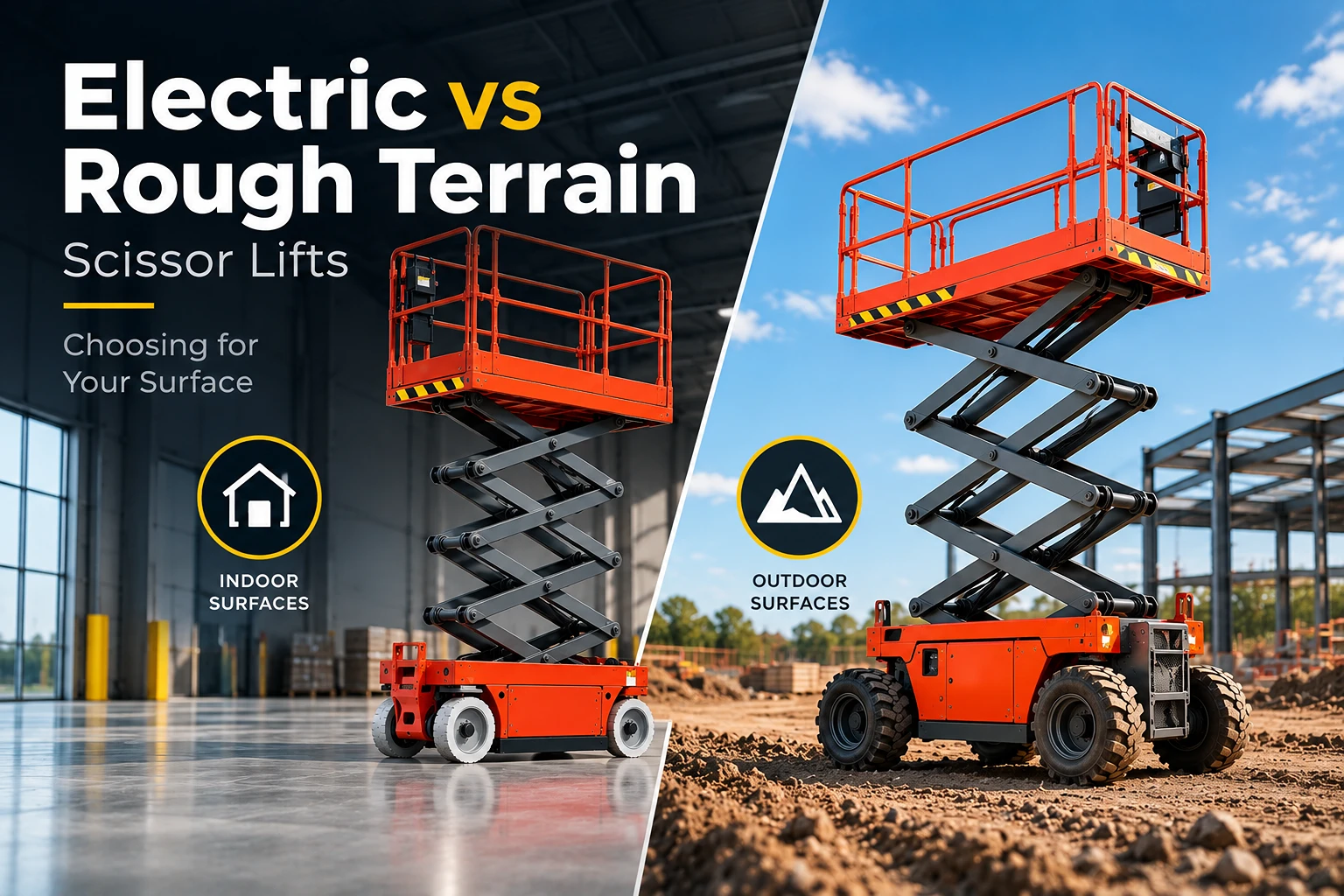
Compact electric slab scissor lifts are designed primarily around maneuverability on firm, level surfaces. Rough terrain models use features such as four-wheel drive, higher ground clearance, aggressive tires and increased gradeability to travel across demanding construction sites.
Choosing incorrectly can result in poor traction, restricted access, unnecessary floor loading, lost productivity or an unsafe operating condition.
For contractors renting a scissor lift in Ontario, surface conditions should be evaluated before working height.
Electric vs Rough Terrain Scissor Lifts at a Glance
| Factor | Electric Slab Scissor Lift | Rough Terrain Scissor Lift |
| Primary environment | Indoor / improved surfaces | Construction-oriented outdoor sites |
| Typical surface | Firm, level concrete or pavement | Suitable compacted outdoor terrain |
| Drive system | Commonly 2WD electric | Commonly 4WD |
| Tires | Solid, often non-marking | Rough-terrain tires |
| Ground clearance | Lower | Higher |
| Gradeability | Lower | Typically greater |
| Machine width | Often compact | Usually wider |
| Indoor maneuverability | Excellent | Limited by size |
| Noise / exhaust | Excellent for indoor work | Depends on powertrain |
| Best application | Warehouses, commercial interiors, maintenance | Construction, exterior installation, outdoor projects |
These are category-level distinctions. Always check the specifications for the exact machine being rented.
The Surface Is the First Decision
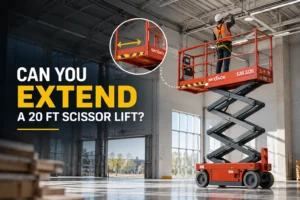
A scissor lift achieves height through a vertically expanding mechanism. Unlike a boom lift, it does not provide substantial horizontal outreach.
That makes stability beneath the chassis fundamental.
Ontario safety guidance states that an elevating work platform should be operated on a firm, stable, horizontal and level surface unless otherwise permitted by the manufacturer. The supporting surface must also be capable of carrying the combined weight of the machine, workers, tools, equipment and materials.
Before choosing a lift, inspect:
- Surface material
- Surface firmness
- Slope
- Holes and depressions
- Curbs and transitions
- Loose gravel
- Mud or standing water
- Floor capacity
- Underground structures
- Travel route
The correct lift is determined by the worst relevant surface the machine must safely negotiate, not simply the surface directly beneath the final work position.
When an Electric Scissor Lift Is Better
For smooth indoor floors and improved surfaces, an electric slab scissor lift is generally the more practical choice.
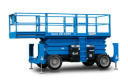
Genie’s GS-1930 E-Drive, for example, is designed for indoor and outdoor applications on firm, level surfaces. It is 2 ft 6 in wide, uses electric drive and has zero inside turning radius, illustrating why this class is useful for restricted interior access.
Electric scissor lifts are particularly effective for:
- Warehouses
- Retail stores
- Schools
- Hospitals
- Offices
- Manufacturing facilities
- Electrical installation
- HVAC maintenance
- Ceiling work
- Lighting replacement
- Suitable paved exterior areas
Choose Electric When:
The surface is firm and level, access is restricted, and compact dimensions matter more than off-road mobility.
When a Rough Terrain Scissor Lift Is Better
A rough terrain scissor lift is designed for more demanding outdoor mobility.
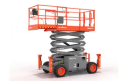
The Genie GS-3369 RT, for example, is a purpose-built four-wheel-drive rough terrain machine. Genie specifies 40% gradeability, positive traction control and foam-filled rough-terrain tires. It is also substantially larger than a compact slab lift, measuring 5 ft 9 in wide and weighing approximately 7,599 lb.
That configuration is more appropriate for applications such as:
- New construction
- Exterior cladding
- Structural work
- Industrial sites
- Outdoor mechanical installation
- Construction sites with unfinished access
- Suitable compacted outdoor terrain
Choose Rough Terrain When:
The machine must travel across an outdoor construction environment that exceeds the mobility capability of a slab scissor lift, while remaining within the manufacturer’s approved operating conditions.
Concrete, Asphalt, Gravel or Dirt: Which Lift?
This is where rental decisions become more useful.
| Surface | Likely Starting Choice | Important Qualification |
| Smooth indoor concrete | Electric | Verify floor capacity and machine dimensions |
| Warehouse floor | Electric | Check floor loading and overhead clearance |
| Finished commercial flooring | Electric | Confirm suitable tire type and floor protection |
| Level paved exterior | Electric may work | Confirm exact model’s outdoor rating |
| Asphalt | Model-dependent | Assess firmness, slope, temperature and manufacturer limits |
| Compacted gravel | Rough terrain | Verify stability and machine instructions |
| Compacted construction surface | Rough terrain | Inspect holes, slopes and soft areas |
| Loose gravel | Requires careful assessment | “Rough terrain” does not eliminate stability limits |
| Soft soil | Do not assume suitability | Ground bearing and stability must be evaluated |
| Mud | Generally unsuitable without specific approval | Loss of traction and stability can become critical |
| Steep slope | Not a normal elevated work position | Follow manufacturer tilt and slope limits |
The phrase rough terrain is not permission to operate anywhere.
That is one of the most important distinctions in the Electric vs Rough Terrain Scissor Lifts decision.
Gradeability Does Not Mean “Safe to Elevate on This Slope”
This is an important specification that contractors can misinterpret.
An electric Skyjack SJ3219 E, for example, lists 25% gradeability. The rough terrain Genie GS-3369 RT lists 40% gradeability.
That does not mean operators should assume either machine can be elevated on a 25% or 40% slope.
Gradeability is a machine travel-performance specification. Elevated-operation limits are governed by separate manufacturer requirements, tilt limits, warnings and operating procedures.
Ontario requires elevating work platforms to be used and moved according to the manufacturer’s written instructions and prohibits loading or using them in a way that affects stability or endangers a worker.
Never use advertised gradeability as the allowable elevated-working slope.
Why Electric Lifts Perform Better Indoors
Electric slab lifts are engineered around a different operating environment.
Consider the difference between two manufacturer examples:
| Specification | Genie GS-1930 Electric | Genie GS-3369 RT |
| Machine width | 2 ft 6 in | 5 ft 9 in |
| Platform capacity | 500 lb | 1,000 lb |
| Drive concept | Compact electric slab lift | 4WD rough terrain |
| Gradeability | Model-specific | 40% |
| Primary advantage | Tight-space maneuverability | Outdoor traction |
| Best surface | Firm, level | Construction-oriented terrain within limits |
The comparison shows why bringing a large rough terrain machine indoors may create unnecessary access and floor-loading challenges, while bringing a compact slab lift onto unfinished ground can create mobility and stability problems.
Do Not Choose by Power Source Alone
Not every outdoor-capable scissor lift is diesel, and not every electric scissor lift is restricted to indoor work.
Modern manufacturers offer electric machines with outdoor ratings and rough-terrain-oriented electric models.
The correct selection criteria are therefore:
- Surface capability
- Working height
- Platform capacity
- Machine width
- Ground clearance
- Tire configuration
- Gradeability
- Indoor/outdoor rating
- Ground or floor capacity
- Manufacturer operating limits
This is more accurate than simply asking for “electric” or “diesel.”
Rental Selection Matrix
For contractors comparing Electric vs Rough Terrain Scissor Lifts, this decision matrix provides a practical starting point:
| Project Condition | Recommended Direction |
| Indoor warehouse maintenance | Electric |
| Shopping centre ceiling work | Electric |
| Factory electrical installation | Electric |
| Finished concrete slab | Electric |
| Tight doorway access | Compact electric |
| Exterior new construction | Rough terrain |
| Compacted outdoor construction site | Rough terrain |
| Greater traction required | Rough terrain |
| Large platform/load requirement | Compare RT and larger slab models |
| Significant horizontal outreach required | Neither: consider a boom lift |
| Unstable or unsupported ground | Stop and assess before selecting equipment |
Five Questions to Ask Before Renting
Before booking a scissor lift, answer these questions:
1. What surface will the machine travel over?
Consider the complete route from unloading to the work position.
2. Is the ground actually firm?
A surface can appear level while still being too soft to adequately support the machine.
3. What is the narrowest access point?
Doorways, gates, aisles and temporary openings can eliminate larger rough terrain models.
4. Will the lift operate outdoors?
Check the exact machine’s outdoor rating, wind restrictions and occupancy limitations.
5. What height and platform capacity are required?
Do not oversize the machine simply to obtain more traction.
Ontario Safety Considerations
For Ontario construction projects, current requirements include operator instruction and training covering manufacturer instructions, load limitations, controls and the limitations of the surfaces on which the equipment is designed to operate. The equipment must also be used and moved in accordance with manufacturer instructions.
Ontario has also enacted a new dedicated Elevating Work Platforms regulation that comes into force on January 1, 2027. Among its requirements, training must address equipment selection, stability factors, workplace risk assessment, hazard identification, travelling procedures and route inspections. It also requires signs identifying the specific firm-level surface conditions required for elevated use.
That reinforces a basic rule:
Surface selection is a safety decision, not merely a productivity decision.
Why Rent the Right Scissor Lift From NAM Rentals?
For contractors comparing Electric vs Rough Terrain Scissor Lifts, the objective should not be to rent the largest or most powerful machine.
It should be to rent the machine that matches:
- Surface conditions
- Required working height
- Platform load
- Building or site access
- Indoor or outdoor operation
- Travel route
- Project duration
- Jobsite conditions
NAM Rentals helps contractors and project teams select construction equipment rentals in Ontario based on practical jobsite requirements.
Matching the lift to the surface can improve mobility, reduce unnecessary repositioning and avoid paying for rough-terrain capability when the project does not require it.
Final Verdict
The Electric vs Rough Terrain Scissor Lifts decision starts at ground level.
Choose an electric slab scissor lift when the project involves firm, level surfaces, restricted access and indoor or suitable improved-surface work.
Choose a rough terrain scissor lift when the machine must negotiate construction-oriented outdoor surfaces and greater traction, ground clearance or gradeability is required.
But never interpret “rough terrain” as “any terrain.”
The supporting surface must still be appropriate for the machine, and the manufacturer’s limits determine where and how the lift may travel and elevate.
For scissor lift rentals in Ontario, NAM Rentals can help match the machine’s working height, dimensions, surface capability and platform capacity to the actual conditions of the project.
Frequently Asked Questions






 Scissor Lifts
  Forklifts / Telehandlers
  Compact Equipment
  Heavy Earthmoving
  Others