Summary (TL;DR)
An asphalt roller, also called a road roller or asphalt compactor, is a heavy construction machine used to compress freshly laid asphalt into a dense, smooth and durable pavement surface.
For most driveway and parking lot paving projects, a double drum vibratory roller, also known as a tandem roller, is the main machine to evaluate.
However, different paving jobs require different roller configurations.
| Paving Project | Roller to Evaluate | Why |
| Residential asphalt driveway | Compact double drum roller | Manoeuvrability and surface finishing |
| Small blacktop repair | Walk-behind roller or plate compactor | Limited working space |
| Commercial parking lot | Medium tandem vibratory roller | Asphalt compaction and coverage |
| Road resurfacing | Medium or large tandem roller | Production and consistent density |
| Large highway paving | Tandem and pneumatic tire rollers | Multiple compaction stages |
| Thin asphalt overlay | Suitable static or low-impact system | Depends on layer and specification |
| Gravel road base | Single drum soil compactor | Granular base compaction |
| Clay-rich subgrade | Padfoot soil roller | Cohesive soil compaction |
The most important rule: Choose the roller according to the asphalt mixture, pavement thickness, project size and required density.
A heavier roller is not automatically better. Excessive vibration, incorrect timing or the wrong roller configuration can damage freshly placed asphalt.
For Ontario contractors, the correct machine should be selected before paving begins, with delivery, operating weight, drum width and compaction requirements confirmed.
What Is an Asphalt Roller?
An asphalt roller is a compaction machine that applies pressure to freshly laid asphalt.
Depending on its design, the roller may use:
- Static weight
- Vibration
- Oscillation
- Pneumatic tire pressure
These forces help rearrange and consolidate the asphalt mixture.
What does an asphalt roller do?
Its primary purpose is to reduce air voids and help achieve the specified pavement density.
Proper asphalt compaction contributes to:
- Pavement stability
- Resistance to rutting
- Reduced water infiltration
- Surface smoothness
- Improved durability
- Better long-term performance
Why is asphalt compaction important?
Freshly placed asphalt contains air spaces between aggregate particles.
If the pavement is not compacted adequately, it can be more vulnerable to premature deterioration.
However, too much or improperly applied compaction can also cause problems, including shoving, checking or aggregate damage.
A properly compacted asphalt surface is not simply one that looks smooth. It must also meet the project’s density and quality requirements.
What Machine Rolls Over Asphalt?
The machine most commonly used to roll freshly laid asphalt is a tandem drum roller.
It has two steel drums, one at the front and one at the rear.
Many models use vibration to increase compaction effectiveness.
Other asphalt compaction machines include pneumatic tire rollers, oscillatory rollers, combination rollers and smaller walk-behind compactors.
Asphalt roller vs road roller
The terms are often used interchangeably, but road roller is broader.
A road roller may be designed for:
- Asphalt
- Gravel
- Soil
- Road base
- Embankments
An asphalt roller is specifically selected and configured for paving work.
Different Types of Asphalt Rollers
1. Double Drum Vibratory Roller
A double drum vibratory roller has two steel drums.
It is widely used for asphalt paving because it combines rolling coverage with a smooth drum surface.
Best applications:
- Driveways
- Parking lots
- Roads
- Asphalt resurfacing
- Commercial paving
Its vibration settings must be matched to the asphalt mixture and layer thickness.
2. Pneumatic Tire Roller
A pneumatic tire roller uses multiple rubber tires instead of steel drums.
The tires apply pressure and a kneading action to the asphalt.
Best applications:
- Selected intermediate compaction stages
- Highway paving
- Large asphalt projects
- Mixtures requiring pneumatic compaction
Tire pressure, ballast and operating conditions affect performance.
3. Oscillatory Roller
An oscillatory roller uses an oscillating drum motion rather than relying solely on conventional vertical vibration.
It may be useful where lower-impact compaction is required.
Best applications to evaluate:
- Selected thin overlays
- Bridge deck paving
- Vibration-sensitive work
- Specialized asphalt mixtures
The correct application depends on the machine and project specifications.
4. Combination Roller
A combination roller generally uses a steel drum and pneumatic tires.
It combines different compaction mechanisms in one machine.
Best applications:
- Selected asphalt paving operations
- Projects requiring both steel drum and pneumatic contact
- Compact paving applications
5. Walk-Behind Asphalt Roller
A walk-behind roller is a smaller compaction machine operated by a pedestrian.
Best applications:
- Asphalt patches
- Narrow pathways
- Small driveways
- Confined areas
For very small repairs, a suitable plate compactor may be more practical.
Asphalt Roller Types Comparison Chart
| Roller Type | Compaction Method | Common Application | Main Consideration |
| Tandem vibratory | Steel drums with vibration | General asphalt paving | Correct vibration settings |
| Static steel drum | Machine weight | Finishing and selected paving stages | Adequate compaction capacity |
| Pneumatic tire | Tire pressure and kneading | Intermediate compaction | Tire condition and pressure |
| Oscillatory | Oscillating drum | Specialized paving | Mix and layer compatibility |
| Combination | Steel drum and rubber tires | Selected paving projects | Configuration suitability |
| Walk-behind | Static or vibratory | Small repairs | Limited production capacity |
For most conventional asphalt paving projects, a tandem vibratory roller is the logical starting point.
However, larger projects may require multiple rollers operating in a coordinated sequence.
Asphalt Roller Size Chart: Small to Large
Asphalt rollers vary significantly in operating weight and compaction width.
The following ranges are general equipment-selection categories.
| Roller Category | Approximate Operating Weight | Common Application |
| Small walk-behind roller | 200–1,000 kg | Patches and confined areas |
| Compact ride-on tandem roller | 1–3 tonnes | Residential driveways |
| Small-to-medium tandem roller | 3–5 tonnes | Driveways and parking lots |
| Medium asphalt roller | 5–8 tonnes | Commercial paving |
| Large tandem roller | 8–12 tonnes | Roads and larger paving work |
| Heavy paving roller | 12–15+ tonnes | High-production projects |
These ranges are illustrative rather than standardized industry categories. Actual machine weight and dimensions vary by model and configuration.
Example: CAT CB2.7 Utility Compactor
Caterpillar publishes the following specifications for the CB2.7:
| Specification | CAT CB2.7 |
| Operating weight with ROPS | 2,698 kg |
| Compaction width | 1,200 mm |
| Drum diameter | 720 mm |
| Water spray tank | 200 L |
This illustrates a compact ride-on roller suitable for consideration on smaller paving projects.
Example: CAT CB7 Tandem Roller
Caterpillar lists the CB7 with:
| Specification | CAT CB7 |
| Operating weight with cab | 8,885 kg |
| Standard compaction width | 1,500 mm |
| Roller category | Tandem vibratory |
This is an example of a larger asphalt roller intended for more substantial paving operations.
These are manufacturer examples, not confirmed NAM Rentals inventory.
Which Asphalt Roller Is Best for a Driveway?
A compact double drum roller is generally the first machine to evaluate for residential asphalt driveway paving.
However, the correct size depends on:
- Driveway width
- Asphalt layer thickness
- Asphalt mixture
- Site access
- Ground support
- Edges and curbs
- Available turning space
Small residential driveway
A compact ride-on tandem roller may provide sufficient compaction while remaining manoeuvrable.
Narrow driveway or small repair
A walk-behind roller or suitable plate compactor may be more practical where a ride-on machine cannot operate safely.
Large commercial driveway
A medium tandem roller may provide greater production capacity.
Important: A plate compactor may be useful for edges and small repairs, but it should not automatically replace the specified roller on a larger paving project.
Which Asphalt Roller Is Best for Parking Lots?
Parking lots often require consistent compaction across relatively large paved areas.
A medium tandem vibratory roller is commonly used for this work.
For larger projects, contractors may also use pneumatic tire rollers during intermediate compaction.
What should you consider?
- Total paved area
- Asphalt thickness
- Paving production rate
- Required density
- Parking lot geometry
- Drainage slopes
- Obstacles and curbs
A roller that is too small may struggle to keep up with asphalt placement.
A roller that is too large may have difficulty operating around islands, curbs and restricted areas.
The correct roller should match the paving crew’s production rate and the site’s working dimensions.
Which Roller Is Best for Road Construction?
Road construction may require different rollers at different stages.
Stage 1: Subgrade Preparation
A suitable single drum soil compactor may be used to compact the prepared subgrade.
Stage 2: Granular Road Base
A smooth drum soil compactor or another approved machine may be used for granular base compaction.
Stage 3: Asphalt Placement
A tandem vibratory roller is commonly used for asphalt compaction.
Stage 4: Intermediate Compaction
A pneumatic tire roller or another specified compactor may be used.
Stage 5: Surface Finishing
A static steel drum roller, or a vibratory roller operating in static mode, may remove remaining roller marks.
One roller is not necessarily suitable for every stage of road construction.
For a comparison of soil and asphalt equipment, see NAM Rentals’ construction equipment selection guide.
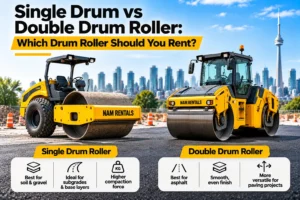
Single Drum vs Double Drum Roller for Asphalt
A single drum soil roller and a double drum asphalt roller have different primary applications.
| Feature | Single Drum Soil Roller | Double Drum Asphalt Roller |
| Typical configuration | Steel drum and rear tires | Two steel drums |
| Primary material | Soil and aggregate | Asphalt |
| Common application | Road base and earthwork | Paving and resurfacing |
| Smooth finish | Not its primary purpose | Designed for paved surfaces |
| Padfoot option | Available on soil compactors | Not typical for asphalt |
| Best project stage | Subgrade and base | Asphalt compaction |
Can a single drum roller compact asphalt?
Some steel drum configurations can perform selected asphalt compaction tasks.
However, a conventional single drum soil compactor is generally not the preferred machine for final asphalt paving.
For most blacktop projects, a tandem asphalt roller is the better starting point.
How to Roll Asphalt Properly: Step-by-Step Guide
Proper asphalt rolling follows a planned sequence of breakdown, intermediate and finish rolling while the mixture remains within its appropriate compaction temperature range.
The exact pattern depends on the asphalt mixture, pavement geometry, equipment and project specifications.
Step 1: Prepare and Compact the Base
Before paving, confirm that the underlying subgrade and granular base meet the required compaction and grading specifications.
An unstable base cannot be corrected simply by rolling the asphalt harder.
Step 2: Confirm Asphalt Placement Conditions
Check:
- Asphalt mixture
- Layer thickness
- Mat temperature
- Weather conditions
- Paver speed
- Required density
The rolling plan should be established before paving begins.
Step 3: Begin Breakdown Rolling
Breakdown rolling is the first compaction stage.
Its purpose is to achieve a substantial portion of the required density while the asphalt is hot enough to compact effectively.
On typical unconfined or sloped mats, rolling often progresses from the low side toward the high side.
However, joint type and pavement geometry may require a different sequence.
Step 4: Follow With Intermediate Rolling
Intermediate rolling continues compaction while the mixture remains workable.
Depending on the project, this stage may use:
- Another tandem roller
- A pneumatic tire roller
- An oscillatory roller
The goal is to achieve the specified density before the mixture cools beyond its effective compaction range.
Step 5: Complete Finish Rolling
Finish rolling removes remaining roller marks and improves surface appearance.
A steel drum roller operating in static mode is commonly used.
The Asphalt Paving Handbook notes that finish rolling is primarily for appearance and smoothness, not for obtaining significant additional density.
Step 6: Inspect the Finished Surface
Check for:
- Roller marks
- Cracking
- Shoving
- Uneven texture
- Surface depressions
- Drainage problems
- Inadequate joint compaction
Complete the required quality-control testing before accepting the work.
Proper Asphalt Rolling Checklist
| Stage | Main Objective | Key Consideration |
| Base preparation | Stable foundation | Required base density |
| Breakdown | Initial asphalt density | Mix temperature |
| Intermediate | Achieve target density | Rolling pattern and timing |
| Finish | Remove roller marks | Static rolling where appropriate |
| Inspection | Verify quality | Density, smoothness and defects |
Do not use a fixed number of passes or one universal temperature for every asphalt mixture. The appropriate rolling plan must be established for the actual paving conditions.
What Temperature Should Asphalt Be Rolled At?
Asphalt must be compacted while the mixture remains sufficiently workable.
However, there is no single correct rolling temperature for every asphalt mix.
Temperature requirements depend on:
- Asphalt binder
- Mix design
- Layer thickness
- Aggregate properties
- Ambient temperature
- Wind
- Base temperature
- Equipment and rolling method
Why does temperature matter?
As asphalt cools, it becomes more resistant to compaction.
If the roller arrives too late, the mixture may no longer achieve the required density.
On the other hand, some mixtures may be unstable at certain temperatures and move under the roller.
Best practice: Follow the asphalt producer’s recommendations, project specifications and established rolling pattern.
How Many Passes Does an Asphalt Roller Need?
There is no universal number of roller passes that guarantees proper asphalt compaction.
The required number depends on the mixture and equipment.
Important factors include:
- Roller weight
- Drum width
- Vibration amplitude
- Vibration frequency
- Asphalt temperature
- Layer thickness
- Travel speed
- Required density
Why more passes are not always better
Excessive or poorly timed rolling can cause:
- Aggregate damage
- Surface checking
- Shoving
- Roller marks
- Unnecessary delays
A test strip or approved compaction procedure may be used to establish the required rolling pattern.
For technical guidance, consult the Asphalt Paving Handbook’s compaction chapter.
Asphalt Roller Rental Cost in Ontario
Asphalt roller rental costs vary by machine size, operating weight, rental duration, delivery location and equipment availability.
A compact walk-behind roller and a large tandem asphalt compactor are different rental products and should not be priced as if they are interchangeable.
NAM Rentals’ reviewed public catalogue does not provide a verified, model-specific asphalt roller rental rate.
Therefore, this guide does not invent daily, weekly or monthly NAM Rentals prices.
What should an asphalt roller rental quote include?
| Cost Component | What to Confirm |
| Base machine | Exact model and operating weight |
| Rental duration | Daily, weekly or monthly |
| Compaction width | Suitable for the project |
| Vibration settings | Required operating modes |
| Water spray system | Working condition and capacity |
| Delivery and pickup | Transportation charges |
| Operating hours | Included allowance |
| Fuel | Return requirements |
| Damage protection | Applicable terms |
| HST | Ontario’s 13% tax |
Daily vs weekly asphalt roller rental
Daily rental: Suitable for short paving projects when the site and asphalt delivery are ready.
Weekly rental: Worth comparing for projects requiring multiple paving days.
Monthly rental: More appropriate for extended roadwork or commercial construction.
Rental tip: Coordinate roller delivery with the paving schedule. A roller arriving late can disrupt compaction, while a roller arriving too early may generate unnecessary rental time.
Asphalt Roller Purchase Price vs Rental Price
Buying and renting a roller involve different costs.
Purchasing an asphalt roller
The purchase price depends on:
- Manufacturer
- Model
- Operating weight
- Age and condition
- Engine hours
- Vibration system
- Drum condition
- Maintenance history
- Included features
New and used roller prices can vary substantially.
Without a specific model and current dealer quotation, there is no reliable universal purchase price.
Renting an asphalt roller
Rental pricing depends on the selected machine and duration.
For occasional paving projects, renting may avoid the costs of ownership, storage, maintenance and transportation between jobs.
For contractors using rollers frequently, ownership may be worth evaluating against total annual rental expenditure.
Do not confuse equipment purchase price with rental cost.
Seven Common Asphalt Roller Mistakes
1. Choosing a Soil Roller for Asphalt Finishing
A conventional soil compactor may not provide the required asphalt finishing performance.
What to do: Select a suitable tandem or other approved asphalt roller.
2. Renting a Roller That Is Too Heavy
Excessive compaction force may damage thin or unstable asphalt layers.
What to do: Match operating weight and vibration settings to the mix and pavement thickness.
3. Starting Rolling Too Late
Asphalt may cool beyond its effective compaction range.
What to do: Coordinate rolling with asphalt placement.
4. Using Incorrect Vibration Settings
Excessive vibration can damage the mat or affect nearby structures.
What to do: Follow the machine and project requirements.
5. Ignoring the Water Spray System
Asphalt may stick to steel drums if the spray system is not functioning correctly.
What to do: Inspect the water system before paving.
6. Turning or Stopping Abruptly on Fresh Asphalt
Poor manoeuvring can create surface defects.
What to do: Use controlled movements and the approved rolling pattern.
7. Comparing Rental Prices Without Delivery
Transportation can materially affect the total cost.
What to do: Request an itemized rental quote.
Ontario Asphalt Roller Safety Requirements
Roller operation presents hazards involving moving equipment, reversing, slopes, hot asphalt and workers on foot.
Essential safety precautions
- Use trained and competent operators.
- Inspect brakes, steering and safety equipment.
- Establish pedestrian exclusion zones.
- Follow manufacturer operating instructions.
- Check ground-bearing capacity.
- Maintain safe clearance from unsupported edges.
- Use appropriate traffic control.
- Assess vibration risks near structures.
- Coordinate roller movements with paving crews.
Ontario Regulation 213/91 requires construction projects to minimize reversing where practical and provides requirements for signallers when reversing presents specified hazards.
Official reference: Ontario Regulation 213/91 — Construction Projects.
Asphalt Roller Rental Checklist
Before Booking
- Confirm the asphalt mixture.
- Determine pavement thickness.
- Measure the paving area.
- Confirm required density.
- Choose the roller configuration.
- Check operating weight and drum width.
- Confirm vibration and static modes.
- Verify water spray system requirements.
- Request complete rental pricing.
Before Delivery
- Confirm paving dates.
- Prepare the unloading area.
- Check site access.
- Arrange trained operators.
- Establish the rolling pattern.
- Confirm quality-control requirements.
Before Operation
- Inspect the machine.
- Check drum condition.
- Verify water spray operation.
- Confirm vibration controls.
- Review site hazards.
- Coordinate with the paving crew.
Why Choose NAM Rentals for Construction Equipment in Ontario?
NAM Rentals supplies construction equipment for excavation, site preparation, material handling and other projects across Toronto and Ontario.
For asphalt paving projects, contractors can explore NAM Rentals’ broader construction equipment catalogue and request information about suitable compaction equipment.
Browse:
Specific asphalt roller models, availability and rental prices must be confirmed directly with NAM Rentals.
When requesting a quote, provide:
- Jobsite location
- Asphalt paving area
- Pavement thickness
- Required compaction equipment
- Rental dates
- Delivery requirements
Call NAM Rentals: +1 647-525-7368
Final Verdict: Which Asphalt Roller Should You Rent?
For most residential driveways and small parking lots, start by evaluating a compact double drum vibratory roller.
For larger commercial paving projects, a medium or heavy tandem roller may be appropriate.
For high-production road paving, contractors may require multiple machines, including pneumatic tire rollers.
For small patches and restricted areas, a walk-behind roller or suitable plate compactor may be sufficient.
The best asphalt roller is the machine that achieves the required density and surface quality without damaging the pavement.
Choose according to the asphalt mixture, layer thickness, project size and compaction specifications, then confirm availability and total rental cost before booking.
FAQ’s







 Scissor Lifts
 Forklifts / Telehandlers
 Compact Equipment
 Heavy Earthmoving
 Others