Summary (TL;DR)
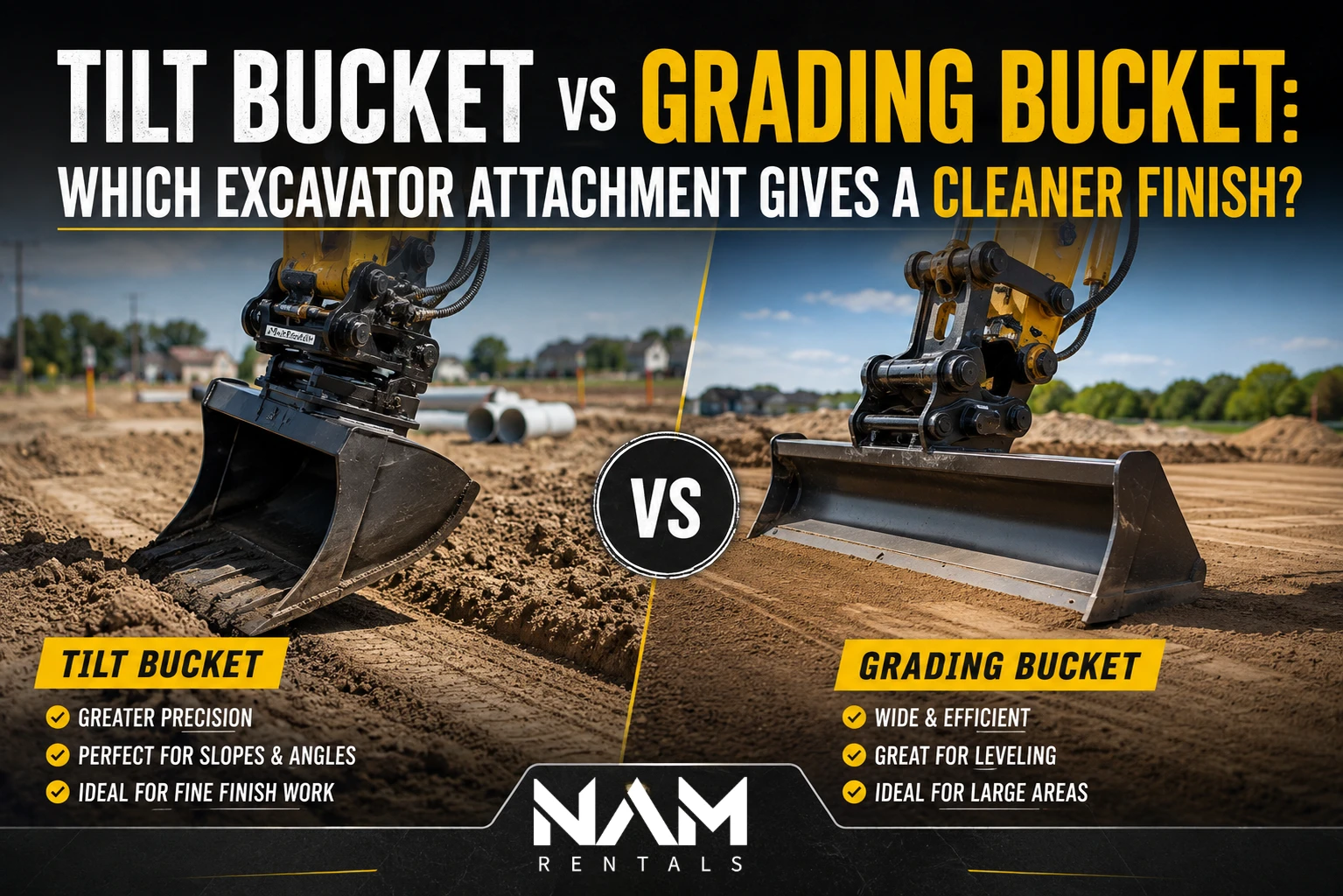
A grading bucket usually gives the cleanest finish on flat, open, and level surfaces. A tilt bucket usually gives the cleanest finish on slopes, ditches, swales, angled edges, and uneven ground because it can tilt without repositioning the excavator as often. Contractors should choose a grading bucket for simple finish grading and backfilling. They should choose a tilt bucket for shaped surfaces, drainage work, and precision grading on uneven terrain. NAM Rentals provides excavator and construction equipment rentals in Ontario for contractors who need the right machine and attachment for the job. Tilt Bucket or Grading Bucket is totally dependent on your needs and requirements.
Introduction
A clean finish is not only about the excavator.
It is about the bucket.
For final grading, ditch shaping, landscaping, pad cleanup, and slope work, contractors often compare two attachments: the tilt bucket and the grading bucket.
Both are designed for finish work.
A grading bucket is simple, wide, smooth, and efficient on flat or open surfaces. A tilt bucket gives the operator angle control without constantly repositioning the excavator.
So which one gives the cleaner finish?
The answer is direct.
A grading bucket usually gives the cleanest finish on flat, open, level areas.
A tilt bucket usually gives the cleanest finish on slopes, uneven ground, ditch banks, swales, edges, and shaped surfaces.
NAM Rentals provides construction equipment rentals in Ontario for contractors, builders, landscapers, property managers, homeowners, and project teams. If you need excavator rental Ontario support, choosing the right bucket can improve finish quality and reduce rework.
Quick Answer
| Attachment | Cleaner Finish When | Main Advantage |
| Grading bucket | The surface is flat, open, and level | Smooth finish with simple control |
| Tilt bucket | The surface is sloped, angled, or uneven | Cleaner shaping with less repositioning |
| Both | Larger finish work with flat areas and slopes | Best result when each bucket is used for the right task |
What Is a Grading Bucket?
A grading bucket is a wide excavator bucket used for shaping, leveling, backfilling, and final cleanup.
It usually has a smooth edge instead of aggressive teeth. That helps it leave a cleaner surface.
Bobcat describes grading buckets as a good choice when the focus is shaping and finishing. Bobcat also notes that grading buckets use a smooth lip for finish grading and backfilling, with a wide low-back profile and longer bottom for better cutting-edge visibility.
Caterpillar also lists grading buckets for cleaning ditches, sloping, grading, and other finishing work.
What Is a Tilt Bucket?
A tilt bucket is a grading-style bucket that can angle left and right.
Instead of repositioning the entire excavator to match the slope, the operator can tilt the bucket hydraulically.
Bobcat describes its tilt bucket as a grading bucket with an integrated hydraulic cylinder that tilts 45 degrees left and right. Bobcat also states that this can save time because the operator can tilt the bucket instead of repositioning the machine.
Caterpillar lists tilting ditch cleaning buckets for ditch cleaning, sloping, grading, and finishing work.
Tilt Bucket vs Grading Bucket Comparison
| Factor | Grading Bucket | Tilt Bucket |
| Finish on flat areas | Excellent | Good |
| Finish on slopes | Moderate | Excellent |
| Ditch shaping | Good | Excellent |
| Pad cleanup | Excellent | Good |
| Around obstacles | Moderate | Strong |
| Repositioning needed | More | Less |
| Operator control | Simple | More advanced |
| Rental cost | Usually lower | Usually higher |
| Hydraulic requirement | Usually none | Requires auxiliary hydraulics |
| Best use | Flat grading and cleanup | Angled finish work and shaping |
When a Grading Bucket Gives the Cleaner Finish
A grading bucket is often the better choice when the surface is open and level.
Use a grading bucket for:
- Final pad cleanup
- Backfilling
- Leveling soil
- Spreading granular material
- Cleaning around foundations
- Finishing flat landscape areas
- Preparing driveways
- Light ditch cleaning
- Site cleanup after excavation
A grading bucket is clean, predictable, and efficient.
It gives the operator a wide cutting edge. That helps create smooth passes over soil, gravel, or other finish material.
For flat work, a tilt bucket may be more attachment than the job needs.
When a Tilt Bucket Gives the Cleaner Finish
A tilt bucket is the better choice when the finish is not flat.
Use a tilt bucket for:
- Sloped yards
- Drainage swales
- Ditch banks
- Roadside edges
- Pond edges
- Berm shaping
- Uneven terrain
- Landscaping contours
- Trench cleanup
- Work around retaining walls
The main advantage is angle control.
A tilt bucket lets the operator match the surface angle without moving the excavator as often. That helps create a cleaner finish on slopes and awkward edges.
AMI Attachments describes hydraulic tilt ditch cleaning buckets as useful for smooth tilting action and a clean finish, with a design aimed at level grading on uneven terrain.
Which Bucket Is Faster?
The faster bucket depends on the site.
| Job Condition | Faster Attachment | Why |
| Flat open pad | Grading bucket | Simple wide passes |
| Long straight cleanup | Grading bucket | Less complexity |
| Ditch bank shaping | Tilt bucket | Less machine repositioning |
| Sloped landscaping | Tilt bucket | Better angle control |
| Tight edges | Tilt bucket | More precise bucket angle |
| Basic backfill | Grading bucket | Efficient material movement |
A grading bucket is faster when the work is simple.
A tilt bucket is faster when the surface changes angle.
Which Bucket Costs Less?
A grading bucket usually costs less to rent and operate.
A tilt bucket may cost more because it is more advanced and needs hydraulic compatibility.
But rental cost should not be the only factor.
If a tilt bucket saves time on slope work, it may reduce total job cost.
If the job is flat, a grading bucket may deliver the same finish for less money.
Cost Decision Table
| Project Type | Better Value |
| Flat pad cleanup | Grading bucket |
| Simple backfill | Grading bucket |
| Landscape contouring | Tilt bucket |
| Drainage swale shaping | Tilt bucket |
| Ditch finishing | Tilt bucket |
| Foundation cleanup | Grading bucket |
| Sloped property work | Tilt bucket |
| General finish grading | Grading bucket |
| Mixed flat and sloped work | Both may be useful |
Cleaner Finish Depends on Operator Skill Too
The attachment matters.
But the operator still matters more.
A skilled operator with a grading bucket can produce excellent finish work. A less experienced operator with a tilt bucket can still leave waves, gouges, and uneven passes.
A cleaner finish comes from:
- Correct bucket selection
- Proper machine size
- Good visibility
- Controlled movements
- Correct bucket angle
- Stable machine position
- Suitable soil moisture
- Proper final passes
- Minimal over-digging
- Good site planning
For finish work, rushing creates rework.
Clean grading is controlled work.
Safety and Site Conditions Still Apply
Finish grading can happen near trenches, slopes, spoil piles, and excavation edges.
That creates risk.
Ontario’s excavation guidance says workers should not enter a trench deeper than 1.2 metres, or 47 inches, unless the walls are sound, made of solid rock, properly sloped, shored, or protected.
If the work is near an excavation edge, plan machine position, spoil placement, slope stability, and worker access before grading begins.
Why NAM Rentals Is a Strong Choice in Ontario
NAM Rentals helps customers choose practical construction equipment rentals in Ontario.
For excavator work, that means selecting the right machine and attachment for the task.
NAM Rentals can help contractors think through:
- Bucket type
- Machine size
- Jobsite access
- Finish quality
- Slope work
- Backfill needs
- Rental duration
- Budget
- Delivery planning
If you are renting an excavator in Ontario, the correct bucket can reduce labour, improve finish quality, and limit rework.
Final Verdict
| Goal | Best Attachment |
| Cleanest flat finish | Grading bucket |
| Cleanest slope finish | Tilt bucket |
| Lowest rental cost | Grading bucket |
| Best angle control | Tilt bucket |
| Best simple cleanup | Grading bucket |
| Best ditch shaping | Tilt bucket |
| Best all-around finish setup | Depends on site conditions |
A grading bucket is the right choice for clean flat work.
A tilt bucket is the right choice for clean angled work.
For many contractors, the smartest decision is not choosing the “better” bucket.
It is choosing the bucket that matches the surface.
For excavator rental Ontario support, contact NAM Rentals. The team can help you choose construction equipment rentals in Ontario that fit your site, finish standard, and budget.
FAQs








 Scissor Lifts
  Forklifts / Telehandlers
  Compact Equipment
  Heavy Earthmoving
  Others