Summary (TL;DR)
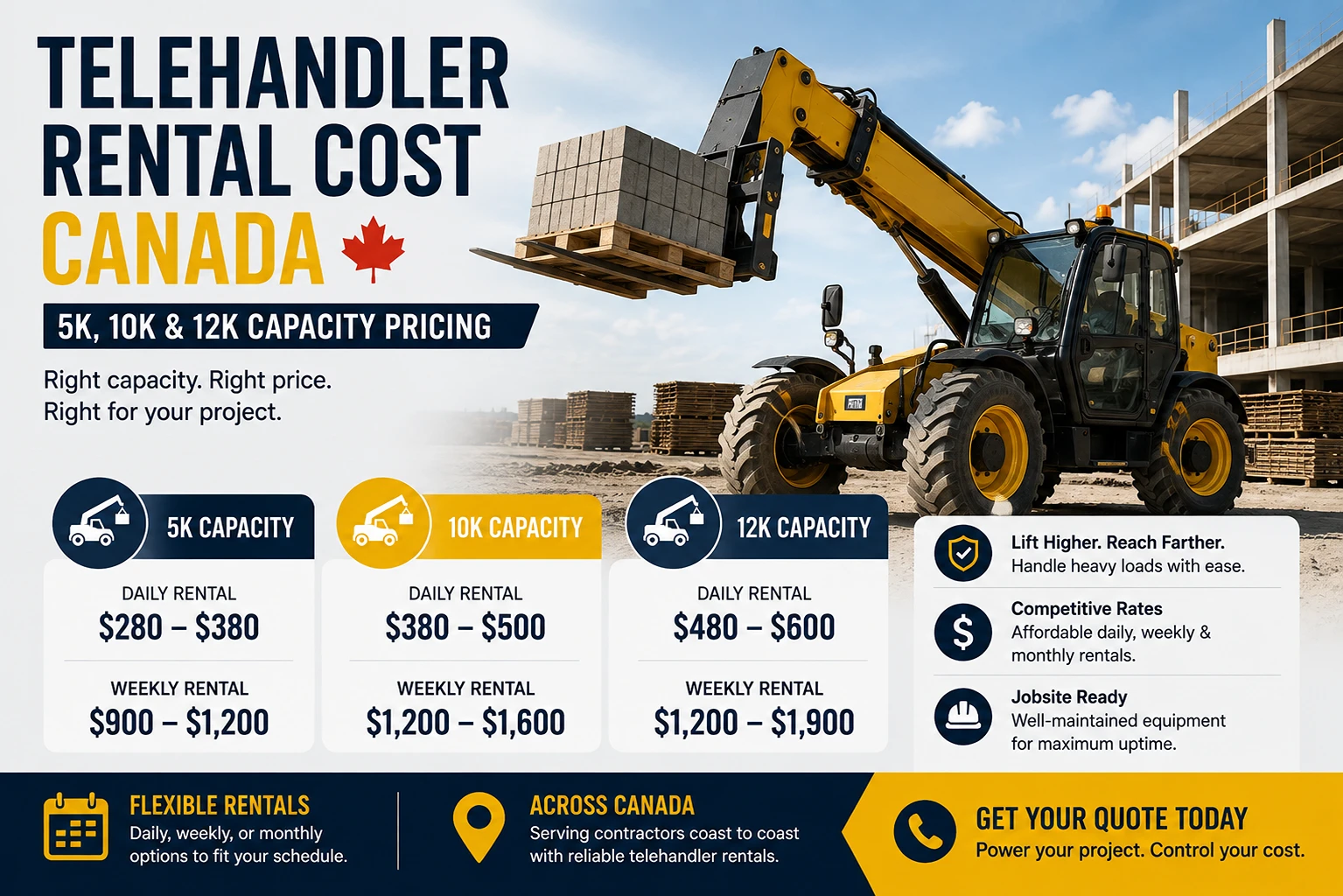
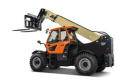
Telehandler rental costs in Canada vary by lifting capacity, boom height, location, rental duration, attachments, delivery, and machine availability. As a current NAM Rentals pricing benchmark, 5,000–6,000 lb telehandlers can range from roughly $250–$368per day, while 10,000 lb machines can commonly fall around $495 per day and 12,000 lb machines can reach approximately $565 per day depending on specification and supplier. Actual rental quotes can differ substantially, so contractors should compare the machine’s load chart and reach rather than capacity alone. NAM Rentals can help Ontario contractors select equipment according to the project’s lifting requirements, access conditions, duration, and budget.
There is no single national telehandler rental price.
A 5,000 lb compact telehandler and a 12,000 lb high-reach machine serve very different purposes. The latter may have substantially greater reach, operating weight, and lifting capability.
Current Canadian rental listings illustrate the spread. One Canadian rental marketplace lists indicative ranges of approximately $400–$600/day for 5,000–6,000 lb machines, $550–$800/day for 8,000–10,000 lb machines, and $800–$1,200/day for 12,000+ lb machines.
NAM Rentals currently lists a 5,000 lb telehandler at $250day, a 10,000 lb model at $495/day, and a 12,000 lb model at $565/day. Its published weekly and monthly rates also demonstrate why rental duration can materially change the economics.
The takeaway is important:
Use published prices as budgeting benchmarks, not guaranteed market rates.
Delivery, machine configuration, attachments, location, season, availability, and rental term can all change the final quote.
Telehandler Rental Cost by Capacity
| Capacity | Typical Canadian Daily Benchmark | Best Suited For |
| 5,000 lb | ~$250 | Residential construction, framing, light material handling |
| 10,000 lb | ~$495 | Commercial construction, roofing, masonry |
| 12,000 lb | ~$565 | Heavy material handling, industrial and infrastructure work |
These are indicative budgeting ranges, not fixed NAM Rentals prices. Actual rates vary by machine, location, rental period, attachment, delivery distance, and availability.
5,000 lb Telehandler: When Does It Make Sense?
A 5,000 lb telehandler is often the economical entry point for contractors who need telescopic reach without the size and cost of a heavy-duty machine.
Typical applications include:
- Residential framing
- Roofing material placement
- Small commercial construction
- Pallet handling
- Truss placement
- General material movement
- Landscaping
For example, Canadian rental listings include compact 5,000 lb machines with short-to-moderate reach capabilities.
Best choice when:
You need moderate capacity, compact dimensions, and economical material handling.
10,000 lb Telehandler: The Construction Workhorse
The 10,000 lb class is often the practical middle ground for contractors who require substantially more lifting capability and reach.
A JLG 1055, for example, has a 10,000 lb rated capacity, a 55 ft maximum lift height, and a maximum forward reach of approximately 42 ft. Its published capacity at maximum height is 5,000 lb and capacity at maximum reach is 3,000 lb.
This illustrates a critical point:
A telehandler’s rated capacity is not its capacity at every position.
The load chart matters.
As the boom extends upward and outward, usable capacity can decrease considerably.
Common applications include:
- Commercial framing
- Masonry
- Roofing
- Structural construction
- Material placement
- Jobsite logistics
- Large residential developments
12,000 lb Telehandler: Maximum Capability Comes at a Price
A 12,000 lb telehandler is designed for heavier material-handling requirements.
JLG’s SkyTrak 12054, for example, has a 12,000 lb rated capacity, a maximum lift height of approximately 53 ft, and a maximum forward reach of about 39 ft. At maximum reach, its published capacity is 3,500 lb.
Genie’s GTH-1256 similarly provides a 12,000 lb maximum lift capacity with approximately 56 ft of lift height and 42 ft of forward reach. Its published capacity at maximum reach is 3,500 lb.
These machines are appropriate when the project genuinely requires higher capacity.
They are not automatically the better rental.
5K vs 10K vs 12K Telehandler
| Factor | 5,000 lb | 10,000 lb | 12,000 lb |
| Rental Cost | Lower | Moderate | Higher |
| Capacity | Light–Moderate | Heavy | Very Heavy |
| Typical Reach | Short–Moderate | Moderate–High | High |
| Residential Work | Excellent | Good | Often excessive |
| Commercial Work | Moderate | Excellent | Excellent |
| Heavy Material | Limited | Excellent | Excellent |
| Transport Requirements | Lower | Higher | Higher |
| Best Value | Smaller projects | General construction | Heavy-duty applications |
Why Rental Duration Changes the Economics
Daily pricing can be misleading.
If a project lasts several weeks, a weekly or monthly rental may provide substantially better value than repeatedly extending daily rentals.
That illustrates why contractors should request pricing for the entire anticipated rental period rather than simply asking for a daily rate.
Before booking, ask for:
- Daily rate
- Weekly rate
- Monthly rate
- Delivery and pickup
- Attachment charges
- Fuel requirements
- Damage or cleaning policies
- Extension rates
The Biggest Pricing Mistake: Choosing by Capacity Alone
A 12,000 lb telehandler is not necessarily the correct choice simply because it can lift more.
The correct machine depends on:
Load weight + load position + lift height + forward reach + attachment + site conditions.
A telehandler’s load chart should always be reviewed for the specific configuration.
This is particularly important when placing heavy materials at height or extended reach.
What Actually Determines Your Rental Price?
| Pricing Factor | Impact |
| Lift capacity | Higher capacity usually increases cost |
| Lift height | High-reach machines command higher rates |
| Rental duration | Longer terms can reduce effective daily cost |
| Location | Local market conditions affect pricing |
| Delivery distance | Heavy equipment transportation can be significant |
| Attachments | Specialized tools may increase rental cost |
| Machine age | Fleet age and specification affect pricing |
| Availability | Peak demand can influence rates |
| Project requirements | Specialized machines cost more |
How to Choose the Right Telehandler
Before requesting a quote, determine five things:
1. What is the heaviest load?
Do not estimate. Check the actual weight.
2. How high must it go?
A machine rated for 10,000 lb may have considerably less capacity near maximum height.
3. How far forward must the load travel?
Forward reach can dramatically change usable capacity.
4. What attachment will you use?
Forks, buckets, truss booms, and other attachments can change the machine’s configuration and capabilities.
5. How long will you need it?
Ask for daily, weekly, and monthly pricing.
This produces a far more defensible rental decision than comparing advertised day rates alone.
When Should You Rent a Telehandler?
Renting generally makes sense when:
- The project is temporary
- Telehandler utilization is inconsistent
- You need a specific capacity for one project
- You want to avoid long-term maintenance obligations
- Storage is limited
- Different projects require different machine sizes
- Capital is better allocated elsewhere
For contractors with occasional material-placement requirements, rental can provide access to specialized equipment without assuming the full financial burden of ownership.
For Ontario contractors, the objective should not simply be to find the lowest advertised rate.
It should be to obtain the right machine at the right total project cost.
NAM Rentals focuses on practical construction equipment rental solutions, helping contractors consider:
- Required lifting capacity
- Working height
- Forward reach
- Jobsite access
- Attachments
- Rental duration
- Delivery requirements
- Project budget
A correctly selected telehandler can reduce unnecessary equipment changes, improve material-handling efficiency, and keep a project moving.
Final Verdict
If your project needs occasional material handling at moderate height, a 5,000 lb telehandler may provide the most economical solution.
If you need a versatile machine for commercial construction and heavier loads, a 10,000 lb telehandler is often the more capable middle ground.
If the project involves substantial loads at considerable height or reach, a 12,000 lb telehandler may justify its higher rental cost.
But capacity is only the beginning.
The real rental decision should be based on the load chart, reach, height, attachment, site conditions, and rental duration.
For telehandler rental in Ontario, contact NAM Rentals to discuss your project requirements and identify a machine that provides the capability you need without paying for capacity you do not.
FAQs – Telehandler Rental Cost Canada




 Scissor Lifts
 Forklifts / Telehandlers
 Compact Equipment
 Heavy Earthmoving
 Others