Summary (TL;DR)
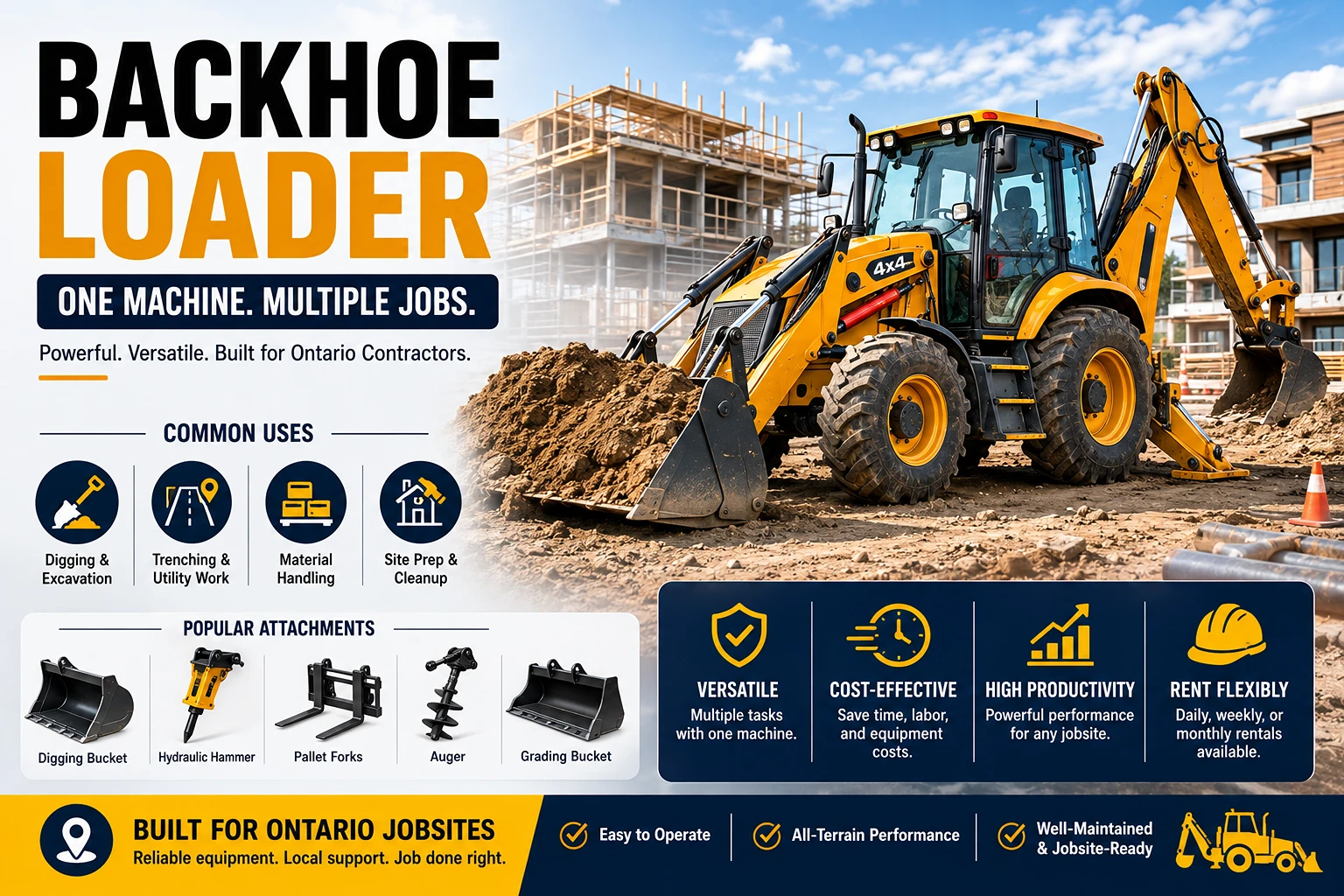
A backhoe loader is a wheeled construction machine that combines a front loader and rear digging arm. It is commonly used for trenching, utility work, drainage, landscaping, road maintenance, material handling, backfilling, and general excavation. Backhoe loaders are particularly valuable when a project requires both digging and material-handling capabilities from one machine. For larger excavation projects or work requiring maximum digging depth and hydraulic power, a dedicated excavator may be more appropriate.
What Is a Backhoe Loader?
A backhoe loader is one of the most versatile machines on a construction site.
It combines three essential functions in one machine:
- A front loader for lifting and moving material
- A rear-mounted backhoe for digging
- A wheeled chassis for travelling between work areas
This combination makes a backhoe loader particularly useful for contractors who need one machine to perform several tasks without bringing multiple pieces of equipment to the site.
A backhoe can excavate a trench, move the excavated material, backfill the trench, load loose material, clear debris, and perform grading work with the right attachment.
For many contractors, that versatility can have a direct impact on equipment costs, transportation, labour, and project scheduling.
NAM Rentals provides construction equipment rentals in Ontario for contractors, builders, landscapers, municipalities, property managers, and other project teams looking for practical equipment solutions.
How Does a Backhoe Loader Work?
A backhoe loader has two primary working ends.
Front Loader
The front bucket is designed for:
- Loading material
- Moving soil
- Backfilling
- Clearing debris
- Leveling
- Carrying aggregate
- General material handling
Rear Backhoe
The rear digging assembly is used for:
- Trenching
- Excavation
- Drainage
- Utility installation
- Foundation work
- Digging footings
- Removing soil
- Breaking or hammering with suitable attachments
The operator can therefore transition between excavation and material handling without changing machines.
That is the central advantage of a backhoe loader.
Why Contractors Use Backhoe Loaders
Construction projects rarely involve only one task.
A utility contractor may need to dig a trench, expose a service, remove excavated material, install the pipe, and backfill the excavation.
A landscaping contractor may need to excavate, move soil, place aggregate, and grade the finished area.
A backhoe loader can handle several of these operations with one machine.
| Project Requirement | Backhoe Loader Advantage |
| Digging | Rear backhoe provides excavation capability |
| Loading | Front bucket handles loose material |
| Backfilling | Front bucket can move soil back into excavation |
| Grading | Loader bucket can level and spread material |
| Material handling | Moves aggregate, soil, and debris |
| Mobility | Wheeled machine can travel between work areas |
| Attachment flexibility | Multiple tools expand capabilities |
7 Common Backhoe Loader Applications
1. Utility Trenching
Backhoe loaders are frequently used for water, drainage, electrical, telecommunications, and other utility projects.
Their combination of digging depth and mobility makes them useful where trenches need to be excavated and backfilled during the same project.
However, contractors must confirm underground utility locations before excavation.
In Ontario, Ontario One Call provides the locate request process for buried infrastructure before digging. (Ontario One Call)
2. Drainage and Culvert Work
Backhoe loaders are well suited to drainage projects.
They can excavate channels, prepare trenches, handle bedding material, place or expose culverts, and backfill once installation is complete.
For agricultural, municipal, residential, and commercial drainage work, this multi-purpose capability can reduce the need for several machines.
3. Landscaping and Site Preparation
A backhoe loader can perform much more than heavy excavation.
Contractors can use appropriate buckets and attachments for:
- Removing unwanted soil
- Preparing landscape beds
- Moving topsoil
- Clearing debris
- Digging drainage trenches
- Preparing foundations
- Spreading aggregate
- Rough grading
For larger landscaping projects, the machine can function as both an excavation and material-handling platform.
4. Road and Municipal Maintenance
Backhoe loaders are commonly used for maintenance rather than only new construction.
Typical work includes:
- Roadside drainage
- Culvert maintenance
- Shoulder repairs
- Utility repairs
- Ditch cleaning
- Material placement
- Stormwater maintenance
Their ability to travel between work locations can be valuable on projects where the machine does not remain in one excavation area all day.
5. Foundation and Footing Excavation
Backhoe loaders can perform excavation for smaller foundations, footings, additions, and other construction work.
The correct machine depends on:
- Required excavation depth
- Soil conditions
- Access
- Bucket size
- Working radius
- Required production rate
For deep commercial foundations or large-volume excavation, a dedicated excavator is generally more appropriate.
6. Material Handling
The front loader makes the backhoe loader particularly useful after excavation is complete.
Instead of bringing another machine simply to move soil or aggregate, the loader bucket can often perform the material-handling work.
This can improve equipment utilization and simplify the jobsite.
7. Snow, Debris, and General Site Work
With the correct attachment, a backhoe loader can also perform seasonal and general maintenance tasks.
Possible attachments include:
- Snow blades
- Snow buckets
- Brooms
- Forks
- Grapples
- Hydraulic hammers
- Augers
- Compaction attachments
Attachment availability varies by machine and rental provider.
Backhoe Loader vs Excavator
One of the most common equipment decisions is choosing between a backhoe and an excavator.
Neither machine is universally better.
The correct choice depends on the work.
| Factor | Backhoe Loader | Excavator |
| Digging | Excellent | Excellent |
| Material handling | Excellent | Good |
| Deep excavation | Good | Excellent |
| Large-scale excavation | Moderate | Excellent |
| Mobility between locations | Excellent | Limited without transport |
| Tight excavation | Good | Excellent |
| Trenching | Excellent | Excellent |
| Loading loose material | Excellent | Moderate |
| Multiple tasks | Excellent | Good |
| Heavy-duty excavation | Good | Excellent |
Choose a Backhoe When:
- The project requires digging and loading
- The machine needs to travel around the site
- You need one versatile machine
- Material handling is part of the work
- The excavation is moderate in scale
- You need multiple attachments
Choose an Excavator When:
- Excavation is the primary task
- Greater digging depth is required
- Large quantities of soil must be moved
- Higher hydraulic performance is needed
- The project requires heavy attachments
- Maximum excavation productivity is the priority
Backhoe Loader Attachments
The attachment can significantly change what a backhoe loader can accomplish.
| Attachment | Common Application |
| General-purpose bucket | Excavation and material handling |
| Narrow trenching bucket | Utility trenching |
| Grading bucket | Fine grading and shaping |
| Hydraulic hammer | Concrete and rock breaking |
| Auger | Holes and post installation |
| Forks | Pallet and material handling |
| Grapple | Logs, debris, and irregular material |
| Broom | Surface cleaning |
| Snow blade | Snow removal |
The correct attachment should be selected according to the material, required finish, machine hydraulic capacity, and manufacturer limitations.
What Size Backhoe Loader Do You Need?
There is no universal “best” backhoe.
The correct size depends on the project.
| Project | Typical Requirement |
| Residential landscaping | Compact or standard backhoe |
| Utility trenching | Standard backhoe |
| Drainage installation | Standard backhoe |
| Road maintenance | Standard or larger machine |
| Commercial excavation | Larger equipment may be preferable |
| Heavy excavation | Dedicated excavator may be better |
Before renting, determine the required:
- Digging depth
- Reach
- Bucket capacity
- Lifting capacity
- Machine width
- Operating weight
- Attachment requirements
Backhoe Loader Rental: What Should Contractors Consider?
The cheapest daily rental rate does not necessarily produce the lowest project cost.
Consider the entire operating picture.
| Cost Factor | Why It Matters |
| Rental rate | Direct equipment expense |
| Rental duration | Longer projects increase total cost |
| Transportation | Larger machines may require specialized hauling |
| Fuel | Affects operating cost |
| Productivity | Determines how quickly work gets completed |
| Attachments | May affect rental cost |
| Downtime | Can increase labour and project costs |
| Delivery timing | Poor scheduling can delay work |
A machine that costs slightly more per day but completes the work significantly faster can be the more economical choice.
How to Choose a Backhoe Rental Company
Before committing to a rental, consider more than price.
A reliable rental provider should offer:
Equipment Condition
The machine should be inspected and maintained according to applicable manufacturer and rental requirements.
Appropriate Equipment
The provider should help match the machine to the project’s requirements.
Attachment Availability
The right bucket or attachment can significantly affect productivity.
Delivery Support
Equipment should arrive when the project needs it and be delivered in a manner suitable for the site.
Rental Flexibility
Short-term and longer-term projects may require different rental arrangements.
Practical Support
Contractors should be able to obtain clear information about machine dimensions, capacity, operating requirements, and attachments.
Backhoe Loader Safety Checklist
Before operating a rental backhoe, inspect the machine.
| Inspection Area | Check |
| Tires | Condition and inflation |
| Hydraulic hoses | Leaks, damage, abrasion |
| Bucket | Teeth, pins, cutting edge |
| Boom and arm | Cracks, damage, hydraulic leaks |
| Loader attachment | Secure connection |
| Brakes | Proper operation |
| Steering | Proper response |
| Lights | Working condition |
| Mirrors | Clean and correctly adjusted |
| Seat belt | Functional |
| Controls | Smooth operation |
| Warning devices | Operational |
| Ground conditions | Stable and suitable |
| Work zone | Workers and hazards controlled |
The operator should also understand the machine’s rated capacity, operating limits, attachment requirements, and site-specific hazards.
Excavation Safety Still Comes First
A backhoe loader does not make excavation automatically safe.
Before digging:
- Confirm utility locates.
- Identify overhead hazards.
- Assess soil conditions.
- Determine whether trench protection is required.
- Keep workers outside the machine’s swing radius.
- Keep spoil and equipment away from unsafe excavation edges.
- Establish safe access and egress.
- Inspect changing ground conditions.
CCOHS identifies cave-ins, underground services, falling materials, hazardous atmospheres, water accumulation, mobile equipment, and overhead electrical hazards among the principal risks associated with trenching and excavation. (CCOHS)
Why Rent a Backhoe Loader Instead of Buying?
For many contractors, ownership makes sense only when equipment utilization is consistently high.
Rental can be more practical when:
- The project is short-term
- Demand varies throughout the year
- Capital needs to remain available for other expenses
- Storage is limited
- Maintenance responsibility should remain with the rental provider
- A specific attachment is needed temporarily
- The contractor needs different machine sizes for different projects
The right decision depends on utilization, project frequency, financing, maintenance, storage, transportation, and expected equipment life.
Why NAM Rentals for Backhoe Loader Rentals in Ontario?
NAM Rentals provides construction equipment rentals in Ontario with a focus on practical jobsite requirements.
For contractors comparing equipment, the objective should be straightforward:
Get the machine that completes the work efficiently without paying for capabilities the project does not require.
NAM Rentals can help customers evaluate:
- Machine size
- Digging requirements
- Job-site access
- Attachment requirements
- Rental duration
- Delivery requirements
- Project conditions
This makes a backhoe loader a practical option for contractors who need one machine capable of performing multiple functions.
Quick Decision Guide
| If Your Project Requires… | Consider |
| Digging + loading | Backhoe Loader |
| Trenching + backfilling | Backhoe Loader |
| Drainage work | Backhoe Loader |
| Roadside maintenance | Backhoe Loader |
| Landscaping | Backhoe Loader |
| Heavy deep excavation | Excavator |
| Large-scale earthmoving | Excavator |
| Maximum digging productivity | Excavator |
| Extremely tight access | Mini Excavator |
| One machine for several tasks | Backhoe Loader |
Final Thoughts
A backhoe loader earns its place on a construction site through versatility.
It can excavate with the rear attachment, move material with the front loader, travel between work areas, and support multiple phases of a project with the appropriate attachments.
That makes it particularly valuable for utility contractors, landscapers, builders, municipalities, property managers, and general contractors.
But versatility should not be confused with universal suitability.
If your project involves deep excavation, extensive earthmoving, or sustained heavy digging, a dedicated excavator may deliver greater productivity.
If your project requires excavation, loading, backfilling, grading, and material handling from one machine, a backhoe loader can be an exceptionally efficient rental choice.
For backhoe loader rental in Ontario, contact NAM Rentals to discuss your project requirements and find equipment that fits the work, site, and schedule.
FAQs – Backhoe Loader Rental Guide








 Scissor Lifts
  Forklifts / Telehandlers
  Compact Equipment
  Heavy Earthmoving
  Others