Summary (TL;DR)
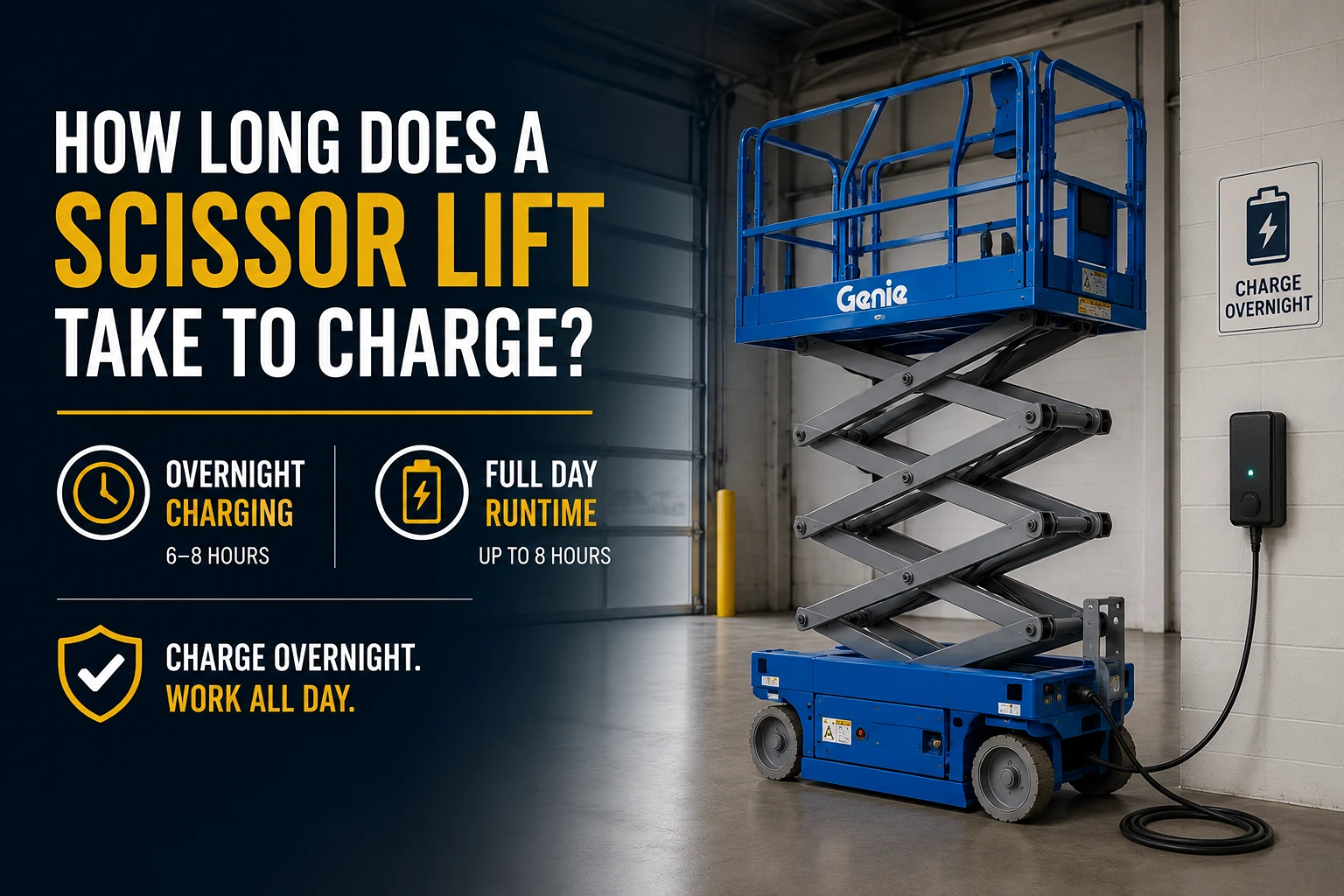
A 24 V scissor lift with a 225 Ah pack and a 25 A onboard charger takes 8 to 10 hours from flat, which is why overnight charging is standard practice. Lithium packs finish in 2 to 4 hours. Expect 4 to 8 hours of runtime per charge on mixed duty.
Introduction
How long does a scissor lift take to charge? Ask the crew that plugged one in at 4 pm and found it half charged at 7 am. Nobody checked whether the site outlet was live, or whether the charger ever reached its absorption stage. A lead-acid pack that stops short of full charge loses a little capacity every night it runs that way, and the crew blames the machine.
How Long Does a Scissor Lift Take to Charge?
Eight to ten hours from a flat lead-acid pack, and 2 to 4 hours for lithium on a matched fast charger. The arithmetic is not complicated. Divide pack capacity by charger output, then add time for the absorption stage.
Most slab machines from Genie, Skyjack and JLG share the same onboard charger: a 24 V, 25 A unit, sold under part numbers 96211, 105739, 161827 and 128537. Behind it sits four 6 V batteries wired to 24 V, usually rated 220 to 225 Ah.
Divide 225 Ah by 25 A and you get 9 hours on paper. Real charging runs longer, because a lead-acid charger only holds full current through the bulk stage, which gets the pack to roughly 80 percent. The absorption and float stages that finish the job take another 3 to 4 hours and cannot be rushed.
Scissor Lift Charging Time Chart
Charge time depends almost entirely on where the pack sits when you plug in. A machine at 50 percent takes less than half the time of a flat one, because the slow finishing stages run the same length either way.
| State of charge at plug-in | Lead-acid (24 V, 225 Ah, 25 A charger) | Lithium (matched fast charger) | Practical window |
| Flat, under 20% | 8 to 12 hours | 2 to 4 hours | Overnight only |
| Half, around 50% | 4 to 6 hours | 1 to 2 hours | Overnight or a long shutdown |
| Topped up, around 80% | 2 to 3 hours | Under 1 hour | Lunch break, lithium only |
| Cold room, under 5 C | Add 2 to 3 hours | Add 30 to 60 minutes | Charge indoors if you can |
One number worth planning around. The onboard charger is a 600 W unit, so it draws roughly 6 to 8 A at 120 V. A single 15 A site circuit runs two lifts safely. Put a third on the same circuit and you will find the breaker tripped at 6 am with three dead machines.
How Long Does a Scissor Lift Battery Last on One Charge?
Four to eight hours of mixed duty, or a full eight-hour shift if the machine mostly sits elevated. Battery runtime falls with drive time, not lift cycles. Driving across a warehouse floor pulls far more current than raising the platform does.
A 19 ft electric scissor lift used for lighting retrofits, parked and raised a dozen times, will finish a shift with charge left. The same machine driven end to end across a 200,000 sq ft distribution centre all day will not. Plan runtime by how far the operator travels.
Can You Charge a Scissor Lift Overnight?
Yes, and overnight charging is the routine the batteries are designed around. Flooded lead-acid packs need one long uninterrupted cycle per day, not several short ones. Follow the same five steps every evening.
- Plug in at the end of the shift, every shift. Do not wait for a low battery warning. Partial charging is what kills these packs.
- Confirm the outlet is live and the charger LED shows bulk. A dead temporary circuit looks identical to a charging machine until morning.
- Leave it connected until the cycle completes. Interrupting a lead-acid charge repeatedly causes sulphation, and sulphation is permanent.
- Check electrolyte after charging, never before. Levels rise during the cycle. Top up with distilled water only, to just above the plates.
- Ventilate the charging area. Flooded cells vent hydrogen while charging, so keep the machine away from enclosed corners and ignition sources.
Three Things That Cut Your Runtime
Ceiling work rarely drains a battery. Cold, sloppy charging habits and long drive distances do.
Cold Weather in Ontario
Lead-acid capacity drops roughly 20 percent near freezing and can fall by a third at -20 C. A pack that ran eight hours in September gives you five in January. Charge indoors when you can, and never leave a discharged pack outdoors in winter.
Chronic Partial Charging
A pack held between 40 and 70 percent for weeks sulphates and loses capacity permanently. This is the most common reason a rental machine feels weak. Give it one full cycle each night rather than three top-ups during the day.
Load, Grade and Drive Distance
Every degree of slope and every extra 100 lb on the deck pulls more current. Occupied platform capacity affects runtime as much as it affects safety. On long indoor runs, drive at half speed and lower the platform before travelling.
Why Choose NAM Rentals for Your Electric Scissor Lift Rental
Every electric scissor lift leaves our Toronto yard on a completed charge cycle, not a partial one, with electrolyte checked and the charger tested under load. Crews across the GTA get a machine that starts Monday at full capacity instead of one that quits at 2 pm. NAM Rentals also tells you what the charger draws before delivery, so your site electrician can plan the circuit rather than discover it. If a pack underperforms mid-project, 24/7 on-site support swaps the unit rather than leaving your crew waiting. Book an
electric scissor lift rental at +1 647-525-7368.
Plug It In Tonight, Not Tomorrow
Before your machine arrives, confirm these three things:
- A live 120 V grounded outlet within cord reach of where the lift parks
- Circuit capacity for every machine you plan to charge at once
- An indoor or sheltered parking spot for winter jobs
Call NAM Rentals at +1 647-525-7368 and we will tell you exactly how long does a scissor lift take to charge on your model, plus the charger draw, before it leaves the yard. Same-day delivery across Toronto and the GTA.
Frequently Asked Questions









 Scissor Lifts
  Forklifts / Telehandlers
  Compact Equipment
  Heavy Earthmoving
  Others