Summary (TL;DR)
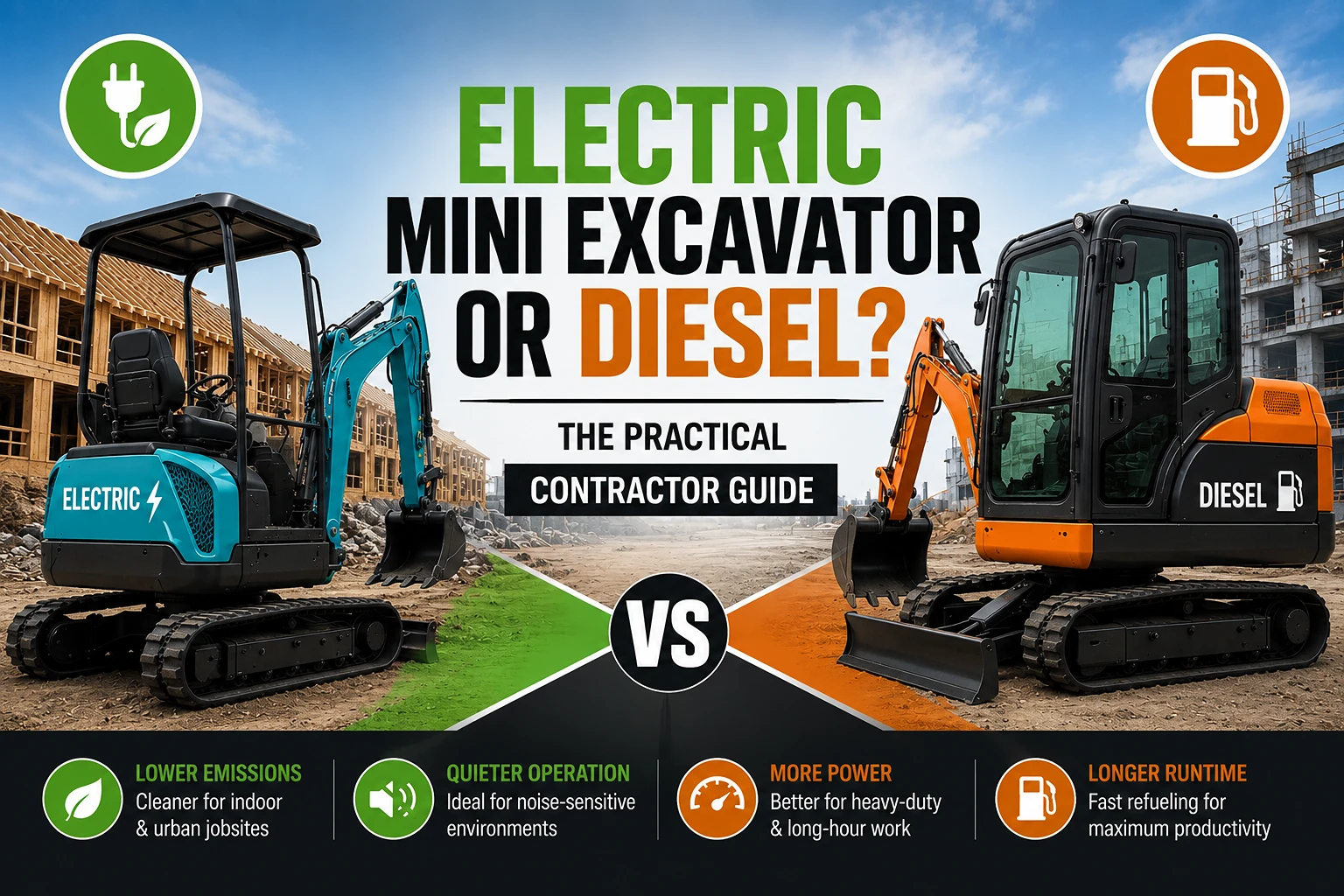
Diesel mini excavators are usually better for long outdoor jobs, remote sites, continuous digging, and projects where fast refueling matters. Electric mini excavators are usually better for indoor work, enclosed spaces, low-noise areas, urban projects, and sites where diesel exhaust is a concern. Electric machines have no tailpipe exhaust during operation, but runtime depends on battery size, duty cycle, and charging access. Contractors should choose based on job duration, ventilation, site power, digging demand, and access. NAM Rentals provides Electric Mini Excavator or Diesel and construction equipment rentals in Ontario for contractors, builders, landscapers, homeowners, and project teams.
Introduction
Diesel and electric mini excavators can both dig.
But they do not fit the same job site.
A diesel mini excavator is still the stronger default for long outdoor days, remote sites, heavy digging, cold starts, and projects where refueling is easier than charging.
An electric mini excavator is the better choice when the job needs low noise, no tailpipe exhaust, indoor access, urban compliance, tight-site work, or work near people.
The correct rental decision is not about trend.
It is about site conditions.
NAM Rentals provides construction equipment rentals in Ontario for contractors, builders, landscapers, property managers, homeowners, and project teams. If you need mini excavator rental Ontario support, this guide will help you choose between diesel and electric with more confidence.
Quick Answer
| Best Choice | Use It When |
| Diesel mini excavator | Outdoor digging, long runtime, remote jobs, heavy production |
| Electric mini excavator | Indoor work, low-noise zones, enclosed spaces, urban projects, emission-sensitive sites |
| Either | Short residential jobs, landscaping, light trenching, utility prep |
| Rent based on site fit | Power source, runtime, ventilation, access, depth, and budget matter most |
Diesel vs Electric Mini Excavators at a Glance
| Factor | Diesel Mini Excavator | Electric Mini Excavator |
| Noise | Higher engine noise | Lower operating noise |
| Tailpipe emissions | Produces diesel exhaust | No tailpipe exhaust during operation |
| Runtime | Strong for full-day outdoor use | Depends on battery size and duty cycle |
| Refueling | Fast diesel refuel | Charging time required |
| Indoor use | Needs exhaust controls and ventilation | Better fit for indoor or enclosed work |
| Remote work | Strong fit | Depends on charging access |
| Maintenance | Engine, filters, fluids, fuel system | Fewer engine-related service points |
| Best job fit | Heavy outdoor production | Sensitive, indoor, urban, and controlled sites |
Noise: Electric Wins in Sensitive Areas
Electric mini excavators are often preferred where noise control matters.
That includes:
| Job Site | Why Electric Helps |
| Schools | Less disruption during operating hours |
| Hospitals | Better fit near occupied buildings |
| Condos | Lower disturbance for residents |
| Retail spaces | Better for off-hour or indoor work |
| Basement work | Less engine noise in confined areas |
| Urban infill sites | Better fit near neighbours and pedestrians |
Volvo lists the ECR25 Electric with a sound pressure level of 74 dB at the operator position and 84 dB sound power around the machine. Volvo also positions the machine for low-noise applications, including indoor work and sites where emissions and noise rules matter.
Bobcat also describes its E10e electric mini excavator as quiet and emission-free, designed for work where other excavators may not be suitable.
For Ontario contractors, noise can affect working windows, complaints, site coordination, and project sequencing. Local noise rules vary by municipality, so confirm project-specific requirements before scheduling noisy work.
Emissions: Electric Wins Indoors and Near People
Diesel engines produce exhaust.
That matters in enclosed spaces, garages, basements, tunnels, indoor demolition areas, warehouses, and covered work zones.
CCOHS states that diesel exhaust is a complex mixture of gases, vapours, aerosols, and particulate substances. It also notes that short-term exposure can irritate the eyes, nose, throat, and respiratory tract, and can worsen asthma or cause breathing symptoms.
IHSA advises that in indoor spaces, diesel exhaust should be vented outdoors with additional hosing where needed, and that diesel exhaust-producing equipment should not be used in enclosed spaces unless controls are in place.
Electric mini excavators do not produce tailpipe exhaust during operation. That does not mean the full energy lifecycle is emission-free. It means there is no diesel exhaust at the work face.
That distinction matters.
For enclosed work, electric can reduce the need for exhaust extraction, improve worker comfort, and make the machine easier to justify in sensitive environments.
Runtime: Diesel Still Wins for Long Uninterrupted Days
Runtime is the main reason diesel still dominates many outdoor job sites.
A diesel mini excavator can be refueled quickly and continue working. That is useful for:
- Full-day trenching
- Larger excavation jobs
- Remote sites
- Cold-weather work
- Heavy digging
- Jobs without power access
- Sites with uncertain schedules
Electric runtime depends on battery capacity, duty cycle, digging intensity, temperature, attachment use, operator habits, and charging setup.
Volvo lists the ECR25 Electric at up to 4 hours of indicative runtime, with about 5 hours for onboard charging and about 50 minutes to reach 80% using off-board fast charging.
Cat lists its 301.9 Electric Mini Excavator with a 48 V, 32 kWh battery and up to 8 hours of runtime on a single charge, based on typical use and 40% to 60% utilization.
Bobcat lists the E19e electric compact excavator with an estimated runtime of 4 hours and a 2-hour off-board charge time.
The conclusion is clear.
Electric can work well for planned shifts, intermittent digging, indoor work, and projects with charging access. Diesel is better when the machine must work continuously with minimal interruption.
Runtime Planning Table
| Question | Choose Diesel If | Choose Electric If |
| Is the job full-day continuous digging? | Yes | Only with charging plan |
| Is the site remote? | Yes | Only if charging is available |
| Is work intermittent? | Either | Electric can fit well |
| Is the job indoors? | Usually no | Yes |
| Is charging available on site? | Not needed | Required |
| Is fast charging available? | Not needed | Strong advantage |
| Is noise a major concern? | Less ideal | Better fit |
Job Site Fit: Where Each Machine Performs Best
| Project Type | Better Fit | Reason |
| Backyard landscaping | Either | Choose based on access and runtime |
| Basement excavation | Electric | Lower noise and no diesel exhaust at point of use |
| Indoor demolition prep | Electric | Better for enclosed work |
| Parking garage trenching | Electric | Lower exhaust concern and less noise |
| Rural drainage work | Diesel | Stronger runtime and refueling flexibility |
| Utility trenching outdoors | Diesel or electric | Depends on depth, runtime, and charging |
| Condo courtyard work | Electric | Better for noise-sensitive areas |
| Large outdoor excavation | Diesel | Longer continuous production |
| School or hospital work | Electric | Lower disturbance and no tailpipe exhaust |
| Remote construction site | Diesel | Easier fueling and less power dependency |
Maintenance and Risk
Diesel machines have engines, fuel systems, filters, oils, belts, cooling systems, and exhaust systems.
Electric machines remove several engine-related service points. But they introduce battery management, charging requirements, cable care, and site power planning.
For rental customers, the practical issue is not full ownership maintenance.
It is downtime prevention.
Before renting, ask:
| Inspection Point | Diesel | Electric |
| Fuel or charge level | Fuel level | Battery state of charge |
| Leaks | Fuel, oil, coolant, hydraulic | Hydraulic and coolant if equipped |
| Start readiness | Engine start and idle | Battery and system status |
| Site support | Fuel access | Charger and outlet access |
| Daily planning | Refuel schedule | Charge schedule |
| Indoor controls | Ventilation needed | Charging and battery safety planning |
Cost: Do Not Compare Rental Rate Alone
The right machine is not always the lowest daily price.
Compare total project cost.
| Cost Factor | Diesel Impact | Electric Impact |
| Fuel or energy | Diesel cost | Electricity cost |
| Downtime | Low if fuel is available | Risk if charging is not planned |
| Indoor ventilation | May add controls | Often reduced exhaust-control need |
| Noise restrictions | May limit work windows | Can support quieter scheduling |
| Productivity | Strong for continuous work | Strong for planned and sensitive work |
| Job approval | May face exhaust restrictions indoors | Better for controlled environments |
Electric may cost more per day in some markets. But it can reduce friction on indoor or sensitive sites.
Diesel may cost less and work longer outdoors. But it may be the wrong fit where exhaust or noise creates constraints.
Decision Matrix
| If Your Priority Is | Best Choice |
| Lowest disruption | Electric |
| Longest uninterrupted outdoor production | Diesel |
| Indoor operation | Electric |
| Remote site flexibility | Diesel |
| No tailpipe exhaust at work face | Electric |
| Simple refueling | Diesel |
| Low-noise job site | Electric |
| Heavy digging over long shifts | Diesel |
| Planned short work windows | Electric |
| Maximum availability in most rental fleets | Diesel |
Why NAM Rentals Is a Strong Choice in Ontario
NAM Rentals helps customers choose construction equipment rentals in Ontario based on actual site conditions.
For mini excavator rentals, that means looking at:
- Dig depth
- Access width
- Indoor or outdoor use
- Noise limits
- Emission concerns
- Runtime needs
- Charging access
- Bucket requirements
- Delivery planning
- Rental duration
NAM Rentals is a reliable option for contractors and project teams that want practical rental guidance, reasonable pricing, and equipment matched to the work.
Final Verdict
| Rent Diesel If | Rent Electric If |
| You need all-day outdoor digging | You need indoor or enclosed work |
| The site has no charging access | The site has power or charging support |
| Refueling speed matters | Low noise matters |
| The project is remote | Tailpipe exhaust is a concern |
| Production matters most | Site sensitivity matters most |
Diesel is the practical workhorse for heavy outdoor production.
Electric is the refined choice for controlled, quiet, emission-sensitive work.
The best rental is the one that fits the site, not the one that sounds better on paper.
For mini excavator rental Ontario support, contact NAM Rentals. The team can help you choose construction equipment rentals in Ontario that fit your site, schedule, and budget.
FAQs







 Scissor Lifts
  Forklifts / Telehandlers
  Compact Equipment
  Heavy Earthmoving
  Others