Summary (TL;DR)
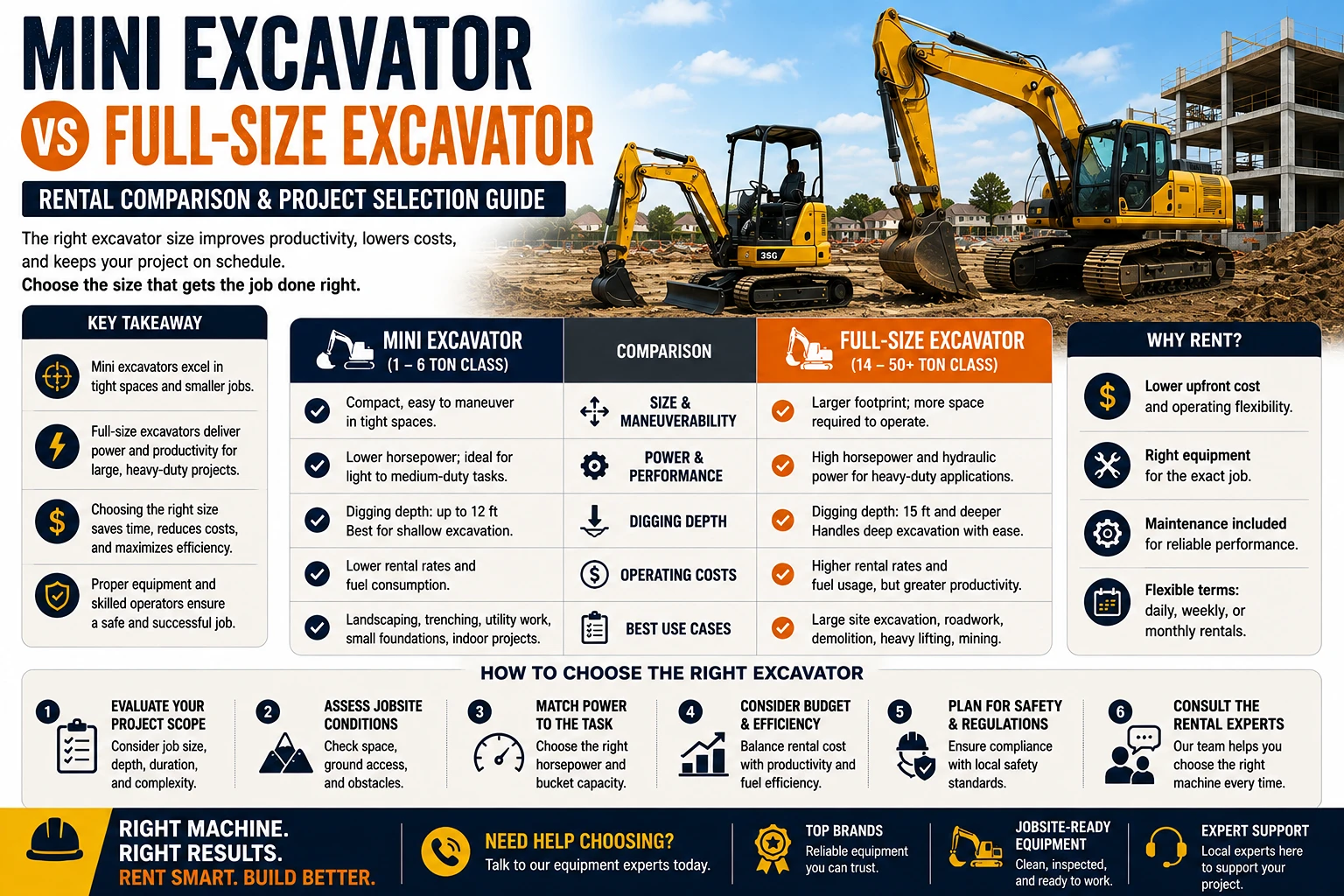
A mini excavator is best for residential projects, landscaping, utility repairs, confined work areas, and jobs with limited access. A full-size excavator is designed for heavy excavation, deep foundations, large-scale earthmoving, demolition, and continuous production work. The correct rental depends on digging depth, lifting requirements, site access, transport logistics, and project duration. NAM Rentals helps contractors across Ontario select the right excavator based on actual jobsite requirements.
Introduction
Choosing the wrong excavator is one of the most expensive mistakes on a construction project.
A machine that is too small can slow production, increase labour costs, and require additional rental days. A machine that is too large may struggle with site access, increase transportation costs, damage finished surfaces, and create unnecessary operating expenses.
The best excavator is not the biggest one.
It is the machine that matches the project.
This guide compares mini excavators and full-size excavators using practical jobsite criteria including productivity, access, digging capability, operating costs, and rental value.
NAM Rentals provides construction equipment rentals throughout Ontario and helps contractors, builders, landscapers, municipalities, and homeowners choose equipment that fits the project instead of simply choosing the largest machine available.
Mini vs Full-Size Excavator at a Glance
| Feature | Mini Excavator | Full-Size Excavator |
| Operating Weight | 1–10 tonnes | 10+ tonnes |
| Digging Depth | Moderate | Deep excavation |
| Lifting Capacity | Light to Medium | Heavy |
| Jobsite Access | Excellent | Requires more space |
| Ground Pressure | Lower | Higher |
| Transportation | Easier | Requires larger trailer |
| Fuel Consumption | Lower | Higher |
| Residential Work | Excellent | Limited |
| Heavy Construction | Limited | Excellent |
| Rental Cost | Lower | Higher |
When a Mini Excavator Is the Better Rental
Mini excavators have become the preferred choice for many contractors because they deliver impressive digging performance while remaining compact enough for restricted spaces.
They are commonly used for:
- Residential construction
- Utility repairs
- Landscaping
- Drainage systems
- Fence installations
- Foundation repairs
- Pool excavation
- Backyard grading
- Tree removal
- Small demolition
Compact dimensions allow operators to work through narrow gates, between buildings, and in established landscapes where larger equipment simply cannot fit.
According to Caterpillar, compact radius excavators are designed to work efficiently in confined spaces while maintaining productivity and minimizing the machine’s swing outside the tracks. This reduces the risk of contacting nearby structures or obstacles. (Source: Caterpillar Compact Radius Excavators)
When a Full-Size Excavator Is the Better Choice
Full-size excavators are production machines.
They are engineered for continuous excavation where power, reach, and hydraulic performance determine project success.
Typical applications include:
- Commercial foundations
- Highway construction
- Bridge projects
- Mass excavation
- Large trenching projects
- Quarry operations
- Site development
- Heavy demolition
- Pipeline installation
- Municipal infrastructure
These machines deliver:
- Greater breakout force
- Higher bucket capacity
- Longer reach
- Greater lifting capacity
- Faster production rates
For contractors moving thousands of cubic metres of soil, productivity often outweighs higher rental costs.
Productivity Comparison
| Task | Mini Excavator | Full-Size Excavator |
| Backyard trenching | ★★★★★ | ★★☆☆☆ |
| Commercial excavation | ★★☆☆☆ | ★★★★★ |
| Foundation digging | ★★★☆☆ | ★★★★★ |
| Utility repairs | ★★★★★ | ★★★☆☆ |
| Road construction | ★★☆☆☆ | ★★★★★ |
| Landscaping | ★★★★★ | ★★☆☆☆ |
| Heavy lifting | ★★☆☆☆ | ★★★★★ |
| Site grading | ★★★☆☆ | ★★★★★ |
Access Makes the Decision
Many rental decisions are determined before digging even begins.
If the excavator cannot reach the work area safely, its power becomes irrelevant.
Consider:
| Site Condition | Better Choice |
| Backyard gate | Mini Excavator |
| Urban infill lot | Mini Excavator |
| Basement excavation | Mini Excavator |
| Parking garage | Mini Excavator |
| Open commercial site | Full-Size |
| Highway project | Full-Size |
| Industrial development | Full-Size |
| Quarry | Full-Size |
Compact excavators reduce the need to remove fencing, landscaping, sidewalks, or temporary structures simply to gain machine access.
Digging Power Comparison
Power matters.
However, many projects require precision more than raw force.
| Capability | Mini | Full-Size |
| Precision excavation | Excellent | Excellent |
| Deep foundations | Moderate | Excellent |
| Heavy clay excavation | Good | Excellent |
| Large rock removal | Limited | Excellent |
| Utility trenching | Excellent | Excellent |
| Drainage work | Excellent | Excellent |
| Bulk earthmoving | Moderate | Excellent |
Volvo Construction Equipment notes that larger excavators are designed for higher production, deeper excavation, and greater lifting performance, while compact excavators provide versatility where access is restricted. (Source: Volvo Construction Equipment Excavator Range)
Which Machine Costs Less? Mini Excavator vs Full-Size Excavator
Many contractors compare only the daily rental rate.
That is often the wrong comparison.
The true cost includes:
- Labour
- Fuel
- Transportation
- Rental duration
- Project delays
- Production rate
- Machine utilization
| Cost Factor | Mini Excavator | Full-Size Excavator |
| Daily Rental | Lower | Higher |
| Fuel | Lower | Higher |
| Transportation | Easier | More expensive |
| Production | Moderate | High |
| Residential Value | Excellent | Limited |
| Commercial Value | Moderate | Excellent |
Sometimes the larger machine finishes the work two days sooner.
Sometimes the smaller machine prevents thousands of dollars in landscape repairs.
The lowest rental price is rarely the lowest project cost.
Rental Selection Checklist
Before renting, answer these questions.
| Question | Why It Matters |
| How deep must you dig? | Determines machine size |
| How wide is site access? | Eliminates oversized equipment |
| Is lifting required? | Larger excavators lift more safely |
| What is the soil condition? | Impacts productivity |
| Is the work residential? | Mini excavators often fit better |
| How many operating hours per day? | Influences production requirements |
| Is transport available? | Larger machines require specialized hauling |
| Are underground utilities present? | Requires careful excavation planning |
Common Rental Mistakes
Avoid these frequent errors.
| Mistake | Better Decision |
| Renting the biggest machine available | Match equipment to the project |
| Ignoring access restrictions | Measure gates and work areas first |
| Choosing based only on price | Compare total project cost |
| Underestimating digging depth | Review project drawings |
| Forgetting transport requirements | Plan delivery before rental |
| Skipping utility locates | Request locates before excavation |
Ontario One Call reminds contractors that buried utilities must be located before excavation begins to help prevent service interruptions, injuries, and costly repairs.
Why Contractors Choose NAM Rentals
NAM Rentals supports contractors throughout Ontario with practical equipment recommendations rather than one-size-fits-all advice.
Customers benefit from:
| Advantage | Benefit |
| Wide equipment selection | Suitable machines for projects of all sizes |
| Competitive rental pricing | Better project cost control |
| Flexible rental periods | Daily, weekly, and long-term options |
| Reliable equipment | Maintained and job-ready fleet |
| Experienced support | Assistance selecting the right machine |
| Fast delivery | Equipment when and where it’s needed |
Whether the project requires a compact excavator for a residential backyard or a larger machine for commercial excavation, selecting the correct equipment improves productivity while reducing unnecessary costs.
Final Recommendation
Choose a mini excavator when:
- Working in confined spaces
- Completing residential projects
- Landscaping
- Utility installation
- Drainage work
- Precision excavation
Choose a full-size excavator when:
- Moving large volumes of material
- Building commercial foundations
- Performing heavy excavation
- Demolishing structures
- Completing infrastructure projects
- Maximizing production
The most successful contractors do not rent the biggest machine.
They rent the right machine.
If you are planning an excavation project anywhere in Ontario, NAM Rentals can help you choose equipment that matches your jobsite, schedule, productivity goals, and budget.
Official Sources
FAQs





 Scissor Lifts
  Forklifts / Telehandlers
  Compact Equipment
  Heavy Earthmoving
  Others