Summary (TL;DR)
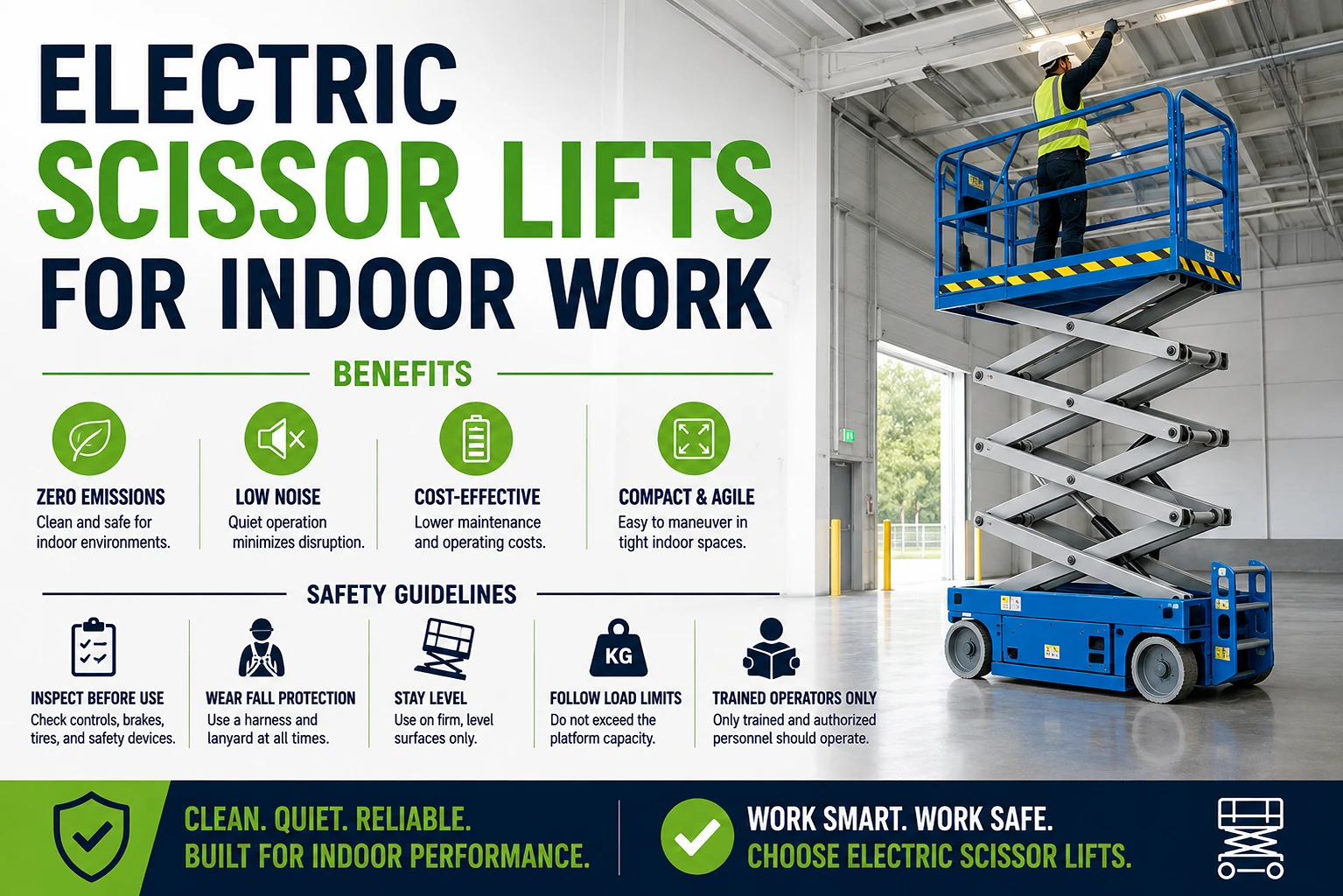
Electric scissor lifts are well suited to indoor work because they operate without diesel exhaust at the work area, generate relatively low noise, and are available in compact configurations for doors and narrow aisles. They are commonly used for lighting, electrical, HVAC, signage, fire protection, warehouse maintenance, and interior finishing. Safe use requires trained operators, a pre-start inspection, firm and level flooring, adequate overhead clearance, controlled pedestrian access, and compliance with the manufacturer’s operating limits. NAM Rentals supplies electric scissor lift rentals for indoor projects across Ontario.
Introduction
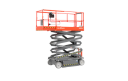
Electric scissor lifts are among the most practical access solutions for indoor construction, installation, maintenance, and facility work.
They elevate workers vertically from a guarded platform. They are compact enough for many commercial interiors and produce no engine exhaust at the point of operation. Electric models also tend to create less operating noise than combustion-powered alternatives.
These advantages make electric scissor lifts suitable for warehouses, retail stores, offices, schools, hospitals, factories, parking structures, and other occupied buildings.
However, indoor suitability does not make a scissor lift automatically safe.
The contractor must still verify floor capacity, doorway clearance, aisle width, overhead hazards, charging arrangements, platform capacity, and operator competency before work begins.
NAM Rentals provides dependable and reasonably priced construction equipment rentals in Ontario. Contractors and facility teams can use NAM Rentals to select an electric scissor lift that fits the building, working height, access route, and project schedule.
Electric Scissor Lift Benefits at a Glance
| Benefit | Practical Value Indoors |
| No engine exhaust at the platform | Better suited to enclosed or occupied buildings |
| Lower operating noise | Reduces disruption around staff, customers, or residents |
| Compact dimensions | Helps with doors, aisles, elevators, and narrow work areas |
| Non-marking tire options | Helps protect finished indoor flooring |
| Vertical platform movement | Efficient for directly overhead tasks |
| Electric drive system | Supports controlled low-speed positioning |
| Guarded work platform | Provides more stable access than many portable ladders |
| Rechargeable power | Eliminates on-site fuel handling during normal use |
Where Electric Scissor Lifts For Indoor Work
Electric scissor lifts are most effective when work is located directly above a firm and level surface.
Typical applications include:
- Warehouse lighting replacement
- Electrical and conduit installation
- HVAC maintenance
- Fire sprinkler work
- Ceiling installation
- Interior painting
- Sign installation
- Security camera work
- Inventory and rack inspection
- Retail store maintenance
- Facility repairs
- Commercial renovation work
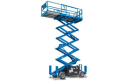
A scissor lift moves primarily in a vertical direction. It is therefore best when the machine can be positioned beneath the work.
When workers must reach over machinery, shelving, walls, or other obstacles, an articulated boom lift or compact mast lift may be more appropriate.
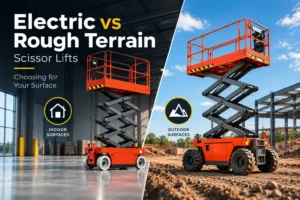
Electric vs Engine-Powered Scissor Lifts
| Selection Factor | Electric Scissor Lift | Engine-Powered Scissor Lift |
| Indoor suitability | Excellent | Limited without appropriate controls |
| Exhaust at point of use | None | Combustion exhaust produced |
| Operating noise | Generally lower | Generally higher |
| Typical surface | Firm and level slab | Outdoor or rough-terrain surfaces |
| Machine footprint | Often compact | Frequently wider and heavier |
| Runtime planning | Battery charge required | Fuel supply required |
| Floor protection | Non-marking tires commonly available | Tire and weight suitability must be checked |
| Best application | Indoor maintenance and construction | Outdoor production and uneven terrain |
1. Confirm Door, Aisle, and Elevator Access
Do not select an indoor scissor lift from working height alone.
Measure the complete access route from the delivery point to the work area.
Check:
| Access Point | What to Verify |
| Building entrance | Clear opening width and height |
| Interior doors | Frame width, threshold, and door swing |
| Hallways | Narrowest point and turning space |
| Warehouse aisles | Rack clearance and aisle-end turning room |
| Elevators | Door width, interior dimensions, and rated capacity |
| Loading docks | Ramp angle, edge protection, and transition points |
| Overhead route | Pipes, beams, signs, lights, and sprinklers |
A machine may pass through a doorway but still be unable to turn inside the next corridor. The full travel route should therefore be surveyed before delivery.
2. Verify Floor Capacity and Surface Condition
Indoor floors should not be assumed suitable because they appear solid.
A contractor should confirm that the supporting surface can carry the machine, occupants, tools, and materials. This is especially important on suspended slabs, mezzanines, older structures, raised floors, parking decks, and elevators.
Inspect the work area for:
- Cracks
- Floor openings
- Drains
- Grates
- Expansion joints
- Debris
- Uneven transitions
- Wet surfaces
- Oil contamination
- Slopes
- Weak or unfinished flooring
The machine must remain within the manufacturer’s slope and stability limits. A scissor lift should not be elevated on an unsuitable incline merely because it can drive across that surface.
3. Control Overhead and Entrapment Hazards
Indoor work often takes place beneath crowded ceiling systems.
Potential hazards include:
- Structural beams
- Sprinkler pipes
- HVAC ducts
- Lighting fixtures
- Cable trays
- Overhead doors
- Low ceilings
- Building services
- Energized electrical equipment
Ontario’s current mobile elevating work platform requirements include training on safe equipment movement beneath structures to avoid trapping or crushing platform occupants. Training must also address workplace risk assessment, machine stability, inspection requirements, and proper use of manufacturer instructions.
Operators should elevate slowly and maintain continuous awareness of the space above and around the platform.
4. Inspect the Lift Before Every Shift
A pre-start inspection should be completed before the lift enters service.
| Inspection Area | What to Check |
| Guardrails and gate | Secure, undamaged, and correctly closed |
| Platform | Clean and free from loose material |
| Controls | Platform and ground controls respond correctly |
| Emergency functions | Emergency stop and emergency lowering work |
| Tires and wheels | Cuts, missing material, debris, or visible damage |
| Hydraulic system | Leaks, damaged hoses, or cylinder problems |
| Pothole protection | Components deploy and are not obstructed |
| Battery system | Charge level, cables, connectors, and compartment condition |
| Warning devices | Horn, alarms, lights, and indicators |
| Decals and manual | Legible safety information and operator manual present |
Ontario’s mobile elevating work platform regulation requires operator training to address inspection and maintenance requirements, including pre-start inspections. It also requires model-specific familiarization when the worker’s training did not cover the particular make and model being used.
Any critical defect should be reported before operation. The machine should not be used until the issue has been assessed and corrected.
5. Respect Platform Capacity
The platform rating includes more than the worker’s body weight.
It also includes:
- Tools
- Materials
- Fixtures
- Parts
- Paint
- Cable
- Testing equipment
- Additional occupants
Never exceed the manufacturer’s rated capacity.
Materials should be arranged so they do not create a trip hazard, interfere with the controls, obstruct the gate, or extend dangerously outside the platform.
Workers should never stand on guardrails, ladders, boxes, or other objects placed on the platform to obtain additional height.
6. Establish a Controlled Work Zone
An indoor lift may operate near workers, customers, warehouse traffic, forklifts, doors, or active production equipment.
Use appropriate controls such as:
- Cones
- Barriers
- Warning signs
- Spotters
- Temporary aisle closures
- Controlled access points
- Work scheduling during quieter periods
The area below the platform should also be controlled where tools or materials could fall.
Operators should avoid travelling with the platform elevated unless permitted by the manufacturer and suitable for the site conditions.
7. Plan Battery Charging Properly
Battery planning affects both safety and productivity.
Before the shift, confirm:
| Charging Item | Required Check |
| Battery level | Sufficient charge for the planned work |
| Charger compatibility | Correct charger for the machine |
| Electrical supply | Suitable outlet and circuit |
| Charging location | Dry, ventilated, and protected from traffic |
| Cable route | No trip, crushing, or vehicle hazard |
| Connector condition | No exposed wiring or damaged plugs |
| Shift planning | Charging scheduled around working periods |
Do not run charging cables through doorways, vehicle routes, wet areas, or locations where they may be crushed.
Only use charging equipment specified or approved for the machine.
8. Confirm Training and Site-Specific Familiarization
General working-at-heights knowledge is not a substitute for equipment-specific competency.
Ontario requires mobile elevating work platform instruction to include theory and practical training for the applicable group and type of equipment. Workers must also demonstrate proficient operation. Where training did not cover the specific make and model, the employer must provide familiarization with its controls, warnings, operating characteristics, and emergency functions.
Workers on Ontario construction projects who are required to use fall-protection equipment must also complete an approved working-at-heights program before using that protection. Equipment-specific instruction remains an additional requirement.
Site supervision should verify:
- Operator training
- Model familiarization
- Manufacturer instructions
- Rescue and emergency procedures
- Fall-protection requirements
- Project-specific hazards
Indoor Scissor Lift Safety Checklist
| Before Operation | Confirm |
| Correct lift selected | ☐ |
| Access route measured | ☐ |
| Floor capacity verified | ☐ |
| Surface firm and level | ☐ |
| Overhead hazards identified | ☐ |
| Pre-start inspection completed | ☐ |
| Operator trained and familiarized | ☐ |
| Platform capacity confirmed | ☐ |
| Pedestrian zone controlled | ☐ |
| Battery sufficiently charged | ☐ |
| Emergency lowering reviewed | ☐ |
| Manufacturer manual available | ☐ |
When an Electric Scissor Lift May Be the Wrong Choice
Choose another access solution when:
- The task requires horizontal outreach
- The ground is soft or severely uneven
- The route exceeds the machine’s slope limits
- The floor cannot support the lift
- Overhead clearance is inadequate
- The platform is too large for the access route
- The project requires outdoor rough-terrain performance
- Battery charging cannot be arranged
- The machine cannot be positioned directly beneath the work
The objective is not merely to obtain sufficient height. The equipment must also fit the building, surface, work method, and surrounding hazards.
Why Rent from NAM Rentals?
NAM Rentals helps contractors and facility teams select construction equipment rentals in Ontario according to actual project conditions.
For indoor scissor lift rentals, the selection process should consider:
| Project Requirement | Rental Consideration |
| Required working height | Platform and machine height |
| Door and aisle access | Overall machine width |
| Floor restrictions | Machine weight and tire type |
| Number of workers | Platform capacity |
| Tools and materials | Rated load and deck dimensions |
| Shift duration | Battery runtime and charging |
| Work environment | Noise, occupancy, and traffic |
| Project schedule | Daily, weekly, or longer rental term |
NAM Rentals offers practical rental guidance, competitive pricing, flexible rental periods, and job-ready equipment for projects across Ontario.
Final Verdict
Electric scissor lifts are an effective indoor access solution when the task is directly overhead and the floor is firm, level, and capable of supporting the machine.
Their compact design, quieter operation, precise controls, and absence of combustion exhaust at the work area make them particularly useful in occupied and enclosed buildings.
Those advantages must be supported by proper planning.
Measure the route. Verify the floor. inspect the machine. Control the work zone. Respect the platform rating. Confirm training. Follow the operator’s manual.
For electric scissor lift rental in Ontario, contact NAM Rentals for assistance selecting a machine that fits your working height, indoor access, floor conditions, schedule, and budget.
FAQs






 Scissor Lifts
  Forklifts / Telehandlers
  Compact Equipment
  Heavy Earthmoving
  Others