Summary (TL;DR)
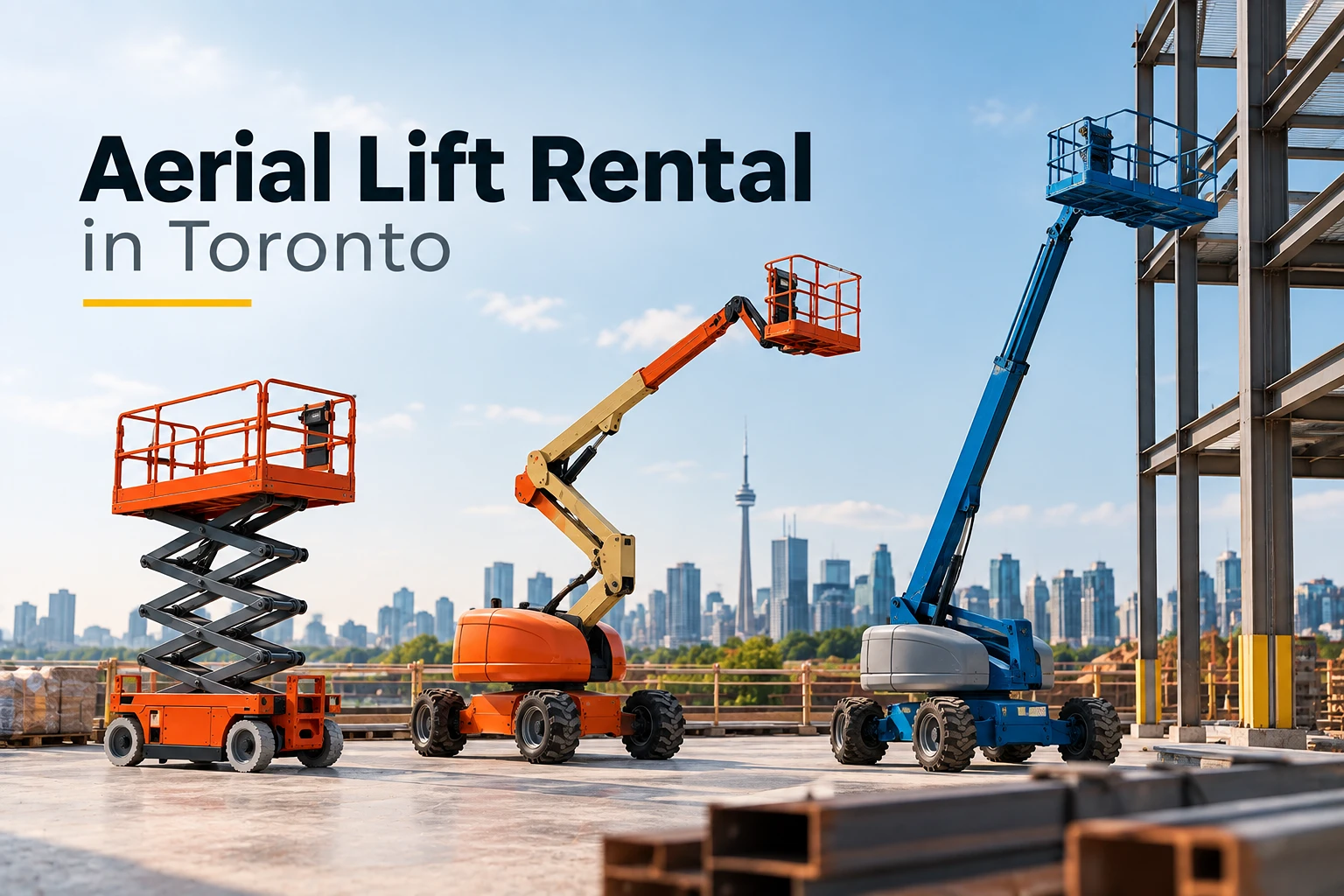
For aerial lift rental Toronto projects, scissor lifts are generally best for vertical access and larger platforms, vertical mast lifts for confined indoor spaces, articulating boom lifts for up-and-over access, and telescopic boom lifts for substantial horizontal reach. Electric slab lifts are commonly suited to firm, level indoor surfaces, while rough-terrain equipment is designed for more demanding outdoor mobility. Toronto rental rates vary significantly by lift type, height, rental period and delivery. Contractors should compare the total project requirement rather than choosing equipment by platform height or daily rate alone.
Introduction
An aerial lift rental in Toronto should be selected around the work position, not simply the maximum height printed on the machine.
A warehouse electrician working directly beneath ceiling fixtures may need a compact electric scissor lift. A technician working in a narrow commercial corridor may be better served by a vertical mast lift. Exterior construction with obstacles can require an articulating boom, while high, unobstructed work may justify a telescopic boom.
The correct rental decision comes down to six variables:
height, horizontal reach, surface, access, platform capacity and work environment.
Selecting the correct combination can reduce repositioning, avoid oversized equipment and improve productive time on site.
What Counts as an Aerial Lift?
“Aerial lift” is commonly used as a broad rental-market term for equipment that elevates workers to a work position.
Ontario’s new Elevating Work Platforms regulation, which comes into force on January 1, 2027, uses the term mobile elevating work platform for mobile machines consisting of a work platform with controls, an extending structure and a chassis. The definition includes self-propelled and boom-type elevating work platforms.
For rental customers, the practical categories include:
| Lift Type | Primary Advantage | Best Application |
| Electric scissor lift | Large vertical work platform | Warehouses, electrical, HVAC, ceilings |
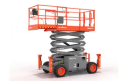
| Rough-terrain scissor lift | Outdoor traction and larger platform | Construction sites and exterior work |
| Vertical mast lift | Very compact access | Retail, offices, warehouses, maintenance |
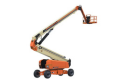
| Articulating boom lift | Up-and-over reach | Work around obstacles |
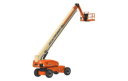
| Telescopic boom lift | Long horizontal reach | High exterior and industrial work |
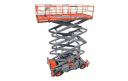
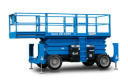
A scissor lift moves primarily vertically and provides a comparatively large work platform.
It is a strong choice when workers can position the machine directly beneath the work.
Typical applications include:
- Electrical installation
- Lighting maintenance
- HVAC work
- Sprinkler installation
- Warehouse maintenance
- Ceiling installation
- Indoor finishing
For an Aerial Lift Rental in Toronto project inside a warehouse or commercial building, an electric slab scissor lift is often the logical starting point.
Best when:
You need vertical height, platform space and compact indoor maneuverability on a suitable firm, level surface.
Rough-terrain scissor lifts are built around more demanding outdoor mobility.
Compared with compact electric slab machines, rough-terrain models commonly offer features such as:
- Four-wheel drive
- Higher ground clearance
- Rough-terrain tires
- Greater gradeability
- Larger platforms
- Higher capacities on some models
But “rough terrain” does not mean “any terrain.”
Ontario requirements state that elevating work platforms must be used and moved according to manufacturer instructions and must not be loaded or operated in a manner that compromises stability.
The supporting surface and exact machine limits must still be verified.
3. Vertical Mast Lift: Best for Tight Spaces
A vertical mast lift is particularly useful when the job requires compact dimensions rather than a large platform.
Canadian rental listings illustrate how compact these machines can be. A 20 ft JLG vertical mast lift listed by LOU-TEC is approximately 29.5 inches wide with a 350 lb platform capacity.
Common applications include:
- Retail maintenance
- Warehouses
- Schools
- Offices
- Commercial facilities
- Lighting replacement
- Inventory work
- Tight aisles
If a scissor lift feels unnecessarily large for a one-person maintenance task, a mast lift deserves consideration.
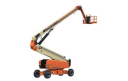
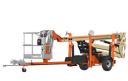
A boom lift solves a different problem.
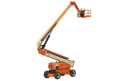
Scissor and basic mast lifts work best when the machine can sit close to or beneath the work. An articulating boom uses multiple boom sections to position the platform up and around obstacles.
Choose one when the work is:
- Behind machinery
- Beyond a wall
- Above landscaping
- Around structural components
- Over production equipment
- Beyond an obstruction
For aerial lift rental Toronto projects where horizontal positioning is essential, a boom lift can prevent repeated machine repositioning.
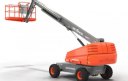
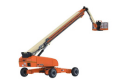
A telescopic or straight boom lift is designed around reach.
It is appropriate when contractors need substantial horizontal access with relatively unobstructed positioning.
Typical work includes:
- Exterior construction
- Industrial maintenance
- Steel work
- Building-envelope projects
- High exterior repairs
- Large commercial sites
If the work is directly overhead, however, renting a large boom may provide expensive capability the project never uses.
Aerial Lift Rental in Toronto Rates
Rental pricing changes by machine type, height, rental period, delivery, availability and supplier.
Current GTA listings provide useful market examples, but they should not be interpreted as NAM Rentals’ guaranteed pricing.
One Toronto-area rental provider currently advertises:
These are advertised GTA rates from one provider and may include provider-specific delivery terms. Prices and availability can change.
Other Canadian rental listings show significant variation. Simplex, for example, currently advertises a 20 ft self-propelled vertical mast lift at $235/day, $618/week and $1,200/month, plus an applicable damage-waiver fee.
The important conclusion:
There is no single “Toronto aerial lift rate.”
Machine specification and rental term matter considerably.
Daily vs Weekly vs Monthly Rental
This is where contractors can save meaningful money.
Do not automatically extend a daily rental one day at a time.
If the project may last several days, ask for:
| Quote Item | Why It Matters |
| Daily rate | Useful for short service work |
| Weekly rate | Can lower the effective daily cost |
| 4-week/monthly rate | Often more economical for longer projects |
| Delivery and pickup | Can materially affect total cost |
| Damage waiver | May be charged separately |
| Fuel/charging terms | Depends on equipment |
| Extension rate | Important if the schedule slips |
| Attachment cost | Relevant to specialized equipment |
The lowest advertised day rate does not necessarily produce the lowest completed-project cost.
How to Choose the Right Aerial Lift
For an Aerial Lift Rental in Toronto project, use this sequence:
Step 1: Determine the Required Work Position
Do you need only vertical height, or horizontal reach as well?
Step 2: Measure Access
Record the narrowest:
- Doorway
- Gate
- Corridor
- Aisle
- Elevator
- Turning point
Step 3: Evaluate the Surface
Determine whether the machine will travel over:
- Finished concrete
- Asphalt
- Compacted gravel
- Construction terrain
- Slopes
- Soft ground
Step 4: Calculate Platform Load
Include:
workers + tools + materials + equipment.
Step 5: Identify Obstacles
Pipes, machinery, walls, shelving and structures can change the lift type entirely.
Fast Selection Table
| If Your Project Requires… | Start With… |
| Indoor vertical work | Electric scissor lift |
| Narrow indoor access | Vertical mast lift |
| Large platform | Scissor lift |
| Outdoor construction terrain | Rough-terrain scissor lift |
| Reach over an obstacle | Articulating boom lift |
| Maximum horizontal reach | Telescopic boom lift |
| Quiet indoor operation | Electric equipment |
| One-person maintenance | Vertical mast lift |
| Several workers and materials | Scissor lift |
Electric vs Rough Terrain Scissor Lifts
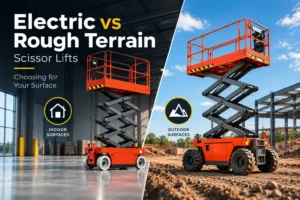
For contractors specifically comparing electric vs rough terrain scissor lifts, the surface should drive the decision.
Choose an electric slab model for suitable firm, level surfaces where compact dimensions and indoor maneuverability matter.
Choose a rough-terrain model when the machine needs construction-oriented outdoor mobility and the exact model is approved for those surface conditions.
Do not select rough-terrain equipment merely because it is “stronger.” Larger machines can introduce additional width, weight and access constraints.
Ontario Safety Requirements
As of September 2026, Ontario’s Construction Projects regulation requires an elevating work platform to be inspected each day before use in accordance with manufacturer instructions. Equipment must remain within its rated working load and be used and moved according to the manufacturer’s written instructions.
Ontario’s new dedicated Elevating Work Platforms regulation takes effect January 1, 2027. It adds detailed provisions concerning training, make/model familiarization, daily inspection, rated loads, manufacturer instructions and required surface-condition information.
For contractors, the practical rule remains straightforward:
Select the correct equipment, inspect it, understand its limits and follow the manufacturer’s instructions.
Aerial Lift Rental Checklist
Before requesting an aerial lift rental in Toronto, provide the rental company with:
- Required platform or working height
- Required horizontal reach
- Number of workers
- Tool and material weight
- Indoor or outdoor use
- Surface conditions
- Narrowest access width
- Overhead obstacles
- Rental duration
- Delivery location
- Expected work schedule
Better information produces better equipment selection.
Why NAM Rentals?
NAM Rentals supports contractors, facility teams and project managers seeking construction equipment rentals across Toronto and Ontario.
The goal should not be to rent the tallest lift available.
The goal is to match height, reach, capacity, surface capability and access to the work while avoiding unnecessary equipment cost.
For an Aerial Lift Rental in Toronto requirement, NAM Rentals can help customers compare practical options for indoor maintenance, construction, installation and elevated access projects.
Final Verdict
Choosing an aerial lift is fundamentally an access problem.
If the work is directly overhead, consider a scissor lift.
If access is extremely restricted, consider a vertical mast lift.
If you need to reach over an obstruction, consider an articulating boom.
If substantial horizontal reach is the priority, consider a telescopic boom.
And if the surface is unfinished or construction-oriented, compare the machine’s terrain capability before booking.
For Aerial Lift Rental in Toronto, selecting the correct equipment class first is usually more important than finding the lowest advertised daily rate.
FAQS – Aerial Lift Rental in Toronto





 Scissor Lifts
  Forklifts / Telehandlers
  Compact Equipment
  Heavy Earthmoving
  Others