Summary (TL;DR)
To avoid scissor lift damage fees, take before and after photos of the full machine, platform, guardrails, tires, controls, battery area, charger, decals, and any existing scratches or dents. Most damage fees come from tire damage, bent guardrails, damaged platform extensions, broken control boxes, pothole protection damage, charger damage, and scraped body panels. NAM Rentals provides construction equipment rentals in Ontario and can help customers choose the right scissor lift for the job. Good documentation, careful operation, and early reporting help reduce rental disputes.
Introduction
Scissor lift damage fees are usually avoidable.
Most issues happen because the equipment was not checked properly before use, damage was not photographed, or the lift was returned with new marks, tire damage, leaks, missing parts, or platform damage.
If you are renting a scissor lift for a job in Ontario, take 10 minutes before and after the rental to document the machine. It can protect your team, your project budget, and your relationship with the rental company.
NAM Rentals provides construction equipment rentals in Ontario for contractors, builders, facility managers, project managers, and homeowners. If you need scissor lift rental Ontario support, NAM Rentals can help you choose the right lift and understand basic rental care before your job starts.
Why Damage Documentation Matters
A scissor lift should be inspected before use. Genie states that a pre-operation inspection is a visual inspection done before each work shift to find anything visibly wrong with the machine before function testing. JLG also advises that inspection and maintenance should follow the original operator’s manual because each model has different components and features.
That means photos are not only for billing protection.
They also help with safer use.
Good documentation can show:
- The lift’s condition at delivery
- Any existing scratches or dents
- Tire condition
- Platform and guardrail condition
- Battery and charger condition
- Control panel condition
- Whether damage happened before or during your rental
This is especially useful for warehouse work, parking garages, indoor renovations, and tight job sites where scissor lifts can get scratched or bumped.
Before-Use Photo Checklist
Take clear photos before using the scissor lift.
Do this before the lift moves from the delivery area.
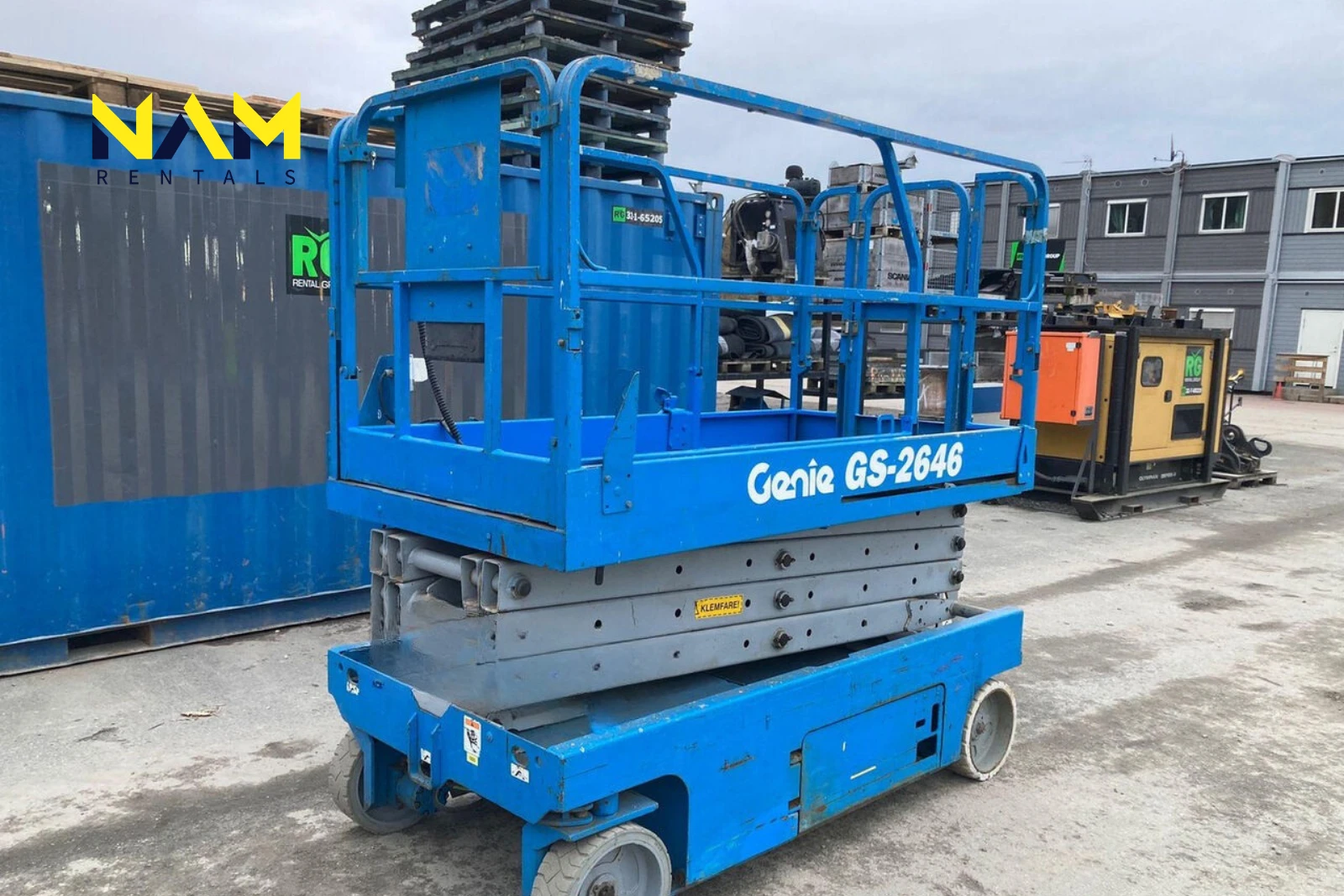
1. Full machine photos
Take photos from all four sides:
- Front
- Back
- Left side
- Right side
Stand far enough back so the full machine is visible.
2. Platform and guardrails
Photograph:
- Guardrails
- Entry gate
- Platform floor
- Platform extension
- Toe boards
- Any dents or bends
Guardrail and platform damage is one of the most common areas that can lead to disputes.
3. Tires and wheels
Take close-up photos of each tire.
Look for:
- Cuts
- Gouges
- Flat spots
- Missing chunks
- Excessive wear
- Embedded debris
Many inspection checklists include wheels and tires as key pre-use items, along with controls, batteries, hydraulic fluid, guardrails, and floor condition.
4. Pothole protection
Photograph the pothole protection system if your lift has one.
This is important for slab scissor lifts used indoors.
Damage to pothole protection bars can happen if the lift is driven over debris, uneven transitions, curbs, or floor obstructions.
5. Controls and decals
Take photos of:
- Lower controls
- Platform controls
- Emergency stop buttons
- Safety decals
- Warning labels
- Hour meter if visible
If a decal is already damaged or missing, document it before use.
6. Battery and charger area
For electric scissor lifts, photograph:
- Battery compartment
- Charger plug
- Charging cable
- Any visible corrosion
- Any existing damage
Avoid pulling charging cables roughly. Charger and plug damage is a common avoidable issue.
7. Existing scratches, dents, or leaks
Take close-ups of any:
- Paint scratches
- Scrapes
- Bent metal
- Cracks
- Oil marks
- Hydraulic leaks
- Loose panels
If something looks wrong, report it before operating the lift.
Most Common Scissor Lift Damage Points
Watch these areas during the rental.
Tires
Tires get damaged by debris, sharp edges, rebar, nails, curbs, and rough floors.
Avoid driving over loose material.
Guardrails
Guardrails often get hit in tight spaces, doorways, warehouse aisles, and parking garages.
Move slowly around columns, pipes, racking, and vehicles.
Platform extension
The extension deck can get damaged if it is forced, overloaded, or hit against a structure.
Use it only as intended.
Control box
The platform control box can get cracked or damaged if it hits walls, beams, racks, or door frames.
Be careful in tight turning areas.
Pothole protection
Pothole bars can be damaged by curbs, ramps, uneven floor transitions, and debris.
Check the route before driving.
Battery charger
Chargers can be damaged by dragging cables, running over cords, pulling plugs at an angle, or leaving cables exposed in busy areas.
Body panels
Side panels often get scratched in narrow aisles, doorways, and garages.
Use a spotter when moving through tight access points.
After-Use Photo Checklist
Before pickup or return, take another full set of photos.
Capture:
- All four sides of the machine
- Platform and guardrails
- Tires
- Controls
- Battery area
- Charger cable
- Any new marks
- Work area where the lift was used
- Hour meter if visible
Keep the photos in one folder with the date, job name, and rental period.
This makes it easier to respond if there is a damage question later.
Simple Habits That Help Avoid Damage Fees
Use these habits on every scissor lift rental:
- Inspect the lift before use
- Photograph everything before moving it
- Check the floor for debris
- Avoid curbs and uneven transitions
- Do not drive into tight spaces without a spotter
- Keep charging cables protected
- Stay within platform capacity
- Do not force gates, rails, or extensions
- Report issues early
- Take after-use photos before pickup
If a lift fails an inspection item, it should be removed from use and reported. Many pre-use inspection checklists follow this basic rule.
Final Thoughts
Damage fees are easier to avoid when you document the lift properly.
Take photos before use.
Take photos after use.
Watch the common damage points.
Use the lift only on suitable surfaces and within the manufacturer’s limits.
If you need scissor lift rental Ontario support or other construction equipment rentals in Ontario, contact NAM Rentals for practical equipment rental guidance.
FAQs
1. How do I avoid scissor lift damage fees?
Take clear before and after photos, inspect the lift before use, avoid rough surfaces, protect the charger, and report existing damage before operating the machine.
2. What photos should I take before using a scissor lift?
Photograph all four sides, tires, platform, guardrails, controls, battery area, charger, decals, and any scratches or dents.
3. What are the most common scissor lift damage points?
Common damage points include tires, guardrails, platform extensions, control boxes, pothole protection, charger cables, and side panels.
4. Should I report existing damage before using the lift?
Yes. Report existing damage before use so it is documented properly.
5. Can tire damage lead to rental fees?
Yes. Cuts, gouges, missing chunks, and embedded debris can lead to damage charges.
6. Does NAM Rentals offer scissor lift rental in Ontario?
Yes. NAM Rentals provides scissor lift rental Ontario support for contractors, facility teams, builders, project managers, and homeowners.
7. Should I inspect a scissor lift every day?
Yes. A pre-use inspection should be completed before use or before each shift, based on the equipment and workplace requirements.
8. What should I do if I notice a leak?
Stop using the lift and report it right away. Do not continue operating equipment that may have a hydraulic or mechanical issue.
9. Are photos enough to avoid every damage fee?
No. Photos help document condition, but the equipment must still be used correctly and returned in proper condition.
10. Why choose NAM Rentals for construction equipment rentals in Ontario?
NAM Rentals offers practical rental support, reasonable pricing, and equipment options for Ontario customers who need reliable construction equipment rentals.





 Scissor Lifts
  Forklifts / Telehandlers
  Compact Equipment
  Heavy Earthmoving
  Others