Summary (TL;DR)
Renting a mini excavator for the first time in Ontario? Start by arranging underground utility locates, measuring site access, choosing the correct machine size and confirming the total rental cost before scheduling delivery.
Follow these seven steps:
- Request utility locates: Contact Ontario One Call before digging. Submit your request at least five business days before the planned start, where applicable, and do not excavate until the required locates and clearances are complete.
- Choose the right size: A 1–3 ton excavator is a common starting point for residential landscaping and drainage.
- Measure access: Check gates, pathways, overhead clearance and ground conditions.
- Confirm rental costs: Ask about the machine, delivery, pickup, fuel, attachments and taxes.
- Prepare for delivery: Provide a suitable unloading location and clear equipment access.
- Check excavation safety: Assess soil stability, trench protection and nearby structures.
- Inspect before use: Review the machine’s condition, controls and operating instructions.
Most important: A rental booking does not authorize excavation. Utility locates, permits, safe excavation planning and operator competency remain the renter’s responsibility.
Can You Rent a Mini Excavator Without Experience?
You can inquire about renting a mini excavator without previous ownership or rental experience, but operating it safely requires appropriate training and competency.
A mini excavator may look simple to operate, but it presents serious hazards involving underground utilities, unstable soil, machine rollover, suspended loads and people working nearby.
For Ontario construction projects, employers and constructors must meet applicable occupational health and safety requirements.
If you have never operated an excavator, consider using a properly trained operator rather than attempting the work without instruction.
Before renting, confirm the rental company’s operator requirements and whether the project needs additional supervision or specialized equipment.
Step 1: Request Underground Utility Locates Before Digging
Underground utility locates should be the first step in your excavation plan, not the last.
Digging without identifying buried services can damage gas, electrical, telecommunications, water or other underground infrastructure.
How to request utility locates in Ontario
- Visit Ontario One Call.
- Submit a locate request with the property address and planned excavation area.
- Identify the work type and proposed start date.
- Allow sufficient time for utility owners to respond.
- Review all locate responses and instructions.
- Confirm that every relevant utility owner has provided a locate or clearance before digging.
Ontario One Call advises submitting locate requests at least five business days before excavation, although some projects may require additional time.
What if there are no underground utilities?
Do not assume the property is clear simply because no utility markings are visible.
Some private services, such as lines running to detached structures or privately installed utilities, may not be covered by the standard public utility locate process.
Additional private locating services may be necessary.
How long are utility locates valid?
Locate validity depends on the applicable documentation, utility owner and site conditions.
Review the expiry dates and conditions on the actual locate responses. Request updates when necessary.
First-time renter mistake: Booking an excavator before the utility locate process is complete, then paying for equipment that cannot legally or safely be used.
Step 2: Choose the Right Mini Excavator Size
The smallest machine is not always the best rental.
A mini excavator must have enough digging depth, reach and capacity to complete the work while fitting safely through the available access.
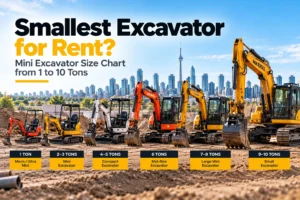
Mini Excavator Size Chart for First-Time Renters
| Excavator Size | Approximate Digging Depth | Best Starting Application |
| 1 ton | 5–6 ft | Small gardens and restricted access |
| 2 ton | 7–8 ft | Backyard drainage and landscaping |
| 3 ton | 8–10 ft | Residential utilities and trenching |
| 5 ton | 10–12 ft | Deeper drainage and foundation work |
| 8 ton | 13–15 ft | Larger utility and commercial projects |
| 10 ton | 14–17 ft | Higher-production excavation |
These are general equipment-class estimates, not specifications for a particular machine. Confirm the exact model’s digging depth, width, reach and operating weight before booking.
Which size should a beginner rent?
For a small residential project, start by evaluating a 1–3 ton machine.
However, do not choose solely by weight.
For example:
- A narrow backyard may require a micro excavator.
- A deeper drainage trench may require a larger machine.
- Rocky or compacted soil may require additional digging capability.
- A restricted site may need a different excavation method.
Read NAM Rentals’ Mini Excavator Dig Depth Guide for additional equipment-selection guidance.
Step 3: Measure Your Property Before Booking
One of the most common first-time rental mistakes is assuming a mini excavator will fit because it is described as compact.
Before booking, measure the entire access route.
| Measurement | What to Check |
| Gate width | Narrowest clear opening |
| Pathway width | Fences, walls and other obstacles |
| Machine height | Garages, branches and overhead structures |
| Ground conditions | Soft soil, slopes and unsupported surfaces |
| Turning space | Room for safe machine movement |
| Tail swing | Clearance when the upper structure rotates |
| Unloading area | Suitable space for safe delivery |
Example: Backyard Excavation in Toronto
Suppose a homeowner has a 36-inch gate and needs a drainage trench.
Some micro excavators have retractable tracks that may allow access through narrow openings.
However, the exact machine width, bucket width, ground conditions and required working clearance must all be checked.
Practical tip: Send the rental company your narrowest access measurement and photographs of the delivery route before confirming the equipment.
Step 4: Understand Mini Excavator Rental Costs in Ontario
The advertised daily rental rate is only one part of the total project cost.
A first-time renter should request a complete quote.
What affects mini excavator rental cost?
| Cost Component | What to Confirm |
| Base machine rental | Daily, weekly or monthly price |
| Delivery | Transportation to the property |
| Pickup | Return transportation |
| Attachments | Bucket, breaker, auger or other tools |
| Operating hours | Included hours and additional usage |
| Fuel | Refuelling requirements |
| Damage protection | Applicable rental terms |
| Late return | Additional rental charges |
| HST | Ontario’s applicable 13% tax |
Daily vs weekly vs monthly rental
Daily rental: Suitable for a short project with a clearly defined scope.
Weekly rental: Worth comparing when excavation may require several days.
Monthly rental: More appropriate for longer construction work.
The lowest advertised daily rate does not always produce the lowest total cost.
Example: How to calculate your rental budget
Your estimated project cost should include:
Machine rental + attachments + delivery + pickup + fuel or other applicable charges + HST
NAM Rentals’ currently reviewed excavator catalogue does not establish a verified published daily price for every 1–10 ton mini excavator class.
For that reason, request a model-specific quote rather than relying on a general price estimate.
For more advice, read How Contractors Can Reduce Excavator Rental Costs.
Step 5: Prepare for Mini Excavator Delivery
Delivery planning can prevent delays, damage and additional charges.
Before delivery
- Confirm the delivery date and estimated arrival window.
- Provide the exact jobsite address and access instructions.
- Identify a suitable unloading area.
- Remove parked vehicles and other obstructions.
- Check overhead wires and structures.
- Confirm that the machine can reach the working area.
- Arrange for an authorized person to receive the equipment.
Can a mini excavator be delivered to a residential driveway?
Possibly, but the driveway must be suitable for the delivery vehicle, unloading procedure and equipment weight.
Do not assume that every driveway can safely support the delivery vehicle or machine.
Discuss site restrictions with the rental company in advance.
What happens during delivery?
Before accepting the equipment:
- Confirm the machine model.
- Inspect for visible damage.
- Check the supplied attachments.
- Review fuel and operating-hour readings.
- Confirm the agreed return procedure.
- Ask for clarification on unfamiliar controls or safety requirements.
First-time renter mistake: Discovering after delivery that the excavator cannot reach the work area.
Step 6: Know Ontario Excavation Safety Requirements
Mini excavator rentals are commonly used for drainage, trenching and foundation preparation.
These projects may create serious excavation hazards.
When is trench protection required in Ontario?
Ontario Regulation 213/91 establishes excavation protection requirements and exceptions.
Excavations less than 1.2 metres deep are subject to a specific exception from the general wall-support requirement.
However, deeper excavations may require an appropriate protective system unless another regulatory exception applies.
Soil type, excavation dimensions, groundwater, nearby structures and other conditions must be considered.
A mini excavator does not make an unprotected trench safe to enter.
Essential excavation precautions
- Complete underground utility locates.
- Identify nearby foundations and buried services.
- Assess soil and groundwater conditions.
- Keep workers clear of the machine’s operating area.
- Do not position equipment on unstable excavation edges.
- Use required trench protection.
- Follow manufacturer operating limits.
- Inspect the excavation as required before worker entry.
For detailed requirements, consult Ontario Regulation 213/91 — Construction Projects.
For excavation projects requiring wall support or worker shielding, review the applicable shoring and trench protection requirements before beginning work.
Step 7: Inspect and Operate the Mini Excavator Safely
Before starting the machine, review the operator’s manual and complete the required pre-use checks.
Basic inspection checklist
| Component | What to Check |
| Tracks | Visible damage and condition |
| Hydraulic hoses | Leaks or damaged connections |
| Bucket and coupler | Proper attachment and locking |
| Controls | Correct operation |
| Warning systems | Alarms and indicators |
| Fluid levels | Manufacturer requirements |
| Safety equipment | Seat belt and protective structures |
| Work area | People, obstacles and ground stability |
Do not operate a machine with an unresolved safety defect.
Common beginner operating mistakes
Moving with the boom extended: This can reduce stability.
Swinging over people: Workers must remain outside hazardous operating areas.
Lifting beyond rated capacity: Excavator lifting limits depend on configuration and position.
Digging too close to utilities: Follow locate instructions and required safe excavation practices.
Working near unstable trench edges: Ground failure can cause rollover or collapse.
Using unfamiliar attachments: Confirm approved compatibility and operator competency before use.
The 10 Most Common First-Time Mini Excavator Rental Mistakes
| Mistake | How to Avoid It |
| Booking before utility locates | Complete the locate process first |
| Choosing by price alone | Compare digging depth, width and capacity |
| Forgetting delivery charges | Request an itemized quote |
| Ignoring gate width | Measure the complete access route |
| Renting the wrong bucket | Confirm attachment requirements |
| Underestimating project duration | Compare daily and weekly rental terms |
| Ignoring soil conditions | Assess stability and digging difficulty |
| Operating without adequate training | Use a competent operator |
| Failing to inspect the machine | Document condition before use |
| Returning late or without required fuel | Confirm return terms in advance |
The most expensive mistake is renting equipment before the site is ready.
A properly planned project reduces idle rental time and avoids preventable equipment changes.
Mini Excavator Rental Checklist: Before, During and After
Use this checklist for your first rental.
Before Booking
- Define the excavation scope and required depth.
- Request Ontario One Call utility locates.
- Check permits and property restrictions.
- Measure site access.
- Select the appropriate machine size.
- Confirm bucket and attachment requirements.
- Obtain an itemized rental quote.
- Confirm operator competency and safety requirements.
Before Delivery
- Complete required utility locates and clearances.
- Prepare the unloading area.
- Remove access obstructions.
- Confirm delivery instructions.
- Identify a safe work area.
- Arrange required excavation protection.
Before Return
- Clean the machine as required.
- Check for damage.
- Confirm fuel requirements.
- Remove personal items.
- Record the return condition.
- Arrange pickup according to the rental agreement.
Why Choose NAM Rentals for Excavator Rental in Ontario?
NAM Rentals supplies construction equipment for excavation, site preparation, material handling and heavy earthmoving projects across Toronto and Ontario.
Its published equipment catalogue includes larger excavators such as the CAT 315F, XCMG XE235C, CAT 330F and Komatsu PC350LC-8.
For smaller projects, contact NAM Rentals to confirm whether a suitable mini excavator is available for your required dates.
Explore:
When requesting a quote, provide the jobsite address, rental dates, access width, digging depth, ground conditions and attachment requirements.
Call NAM Rentals: +1 647-525-7368
Final Verdict: How to Rent a Mini Excavator the Right Way
Renting a mini excavator for the first time becomes much easier when you plan the excavation before booking the equipment.
Start with utility locates, verify access and select a machine that meets the project’s digging requirements.
Then confirm the total rental cost, delivery conditions, operator requirements and return procedure.
For most first-time renters, the biggest savings come from avoiding delays-not simply choosing the lowest daily rental rate.
The best rental is the right machine delivered to a prepared site, with all required safety arrangements completed before work begins.
Frequently Asked Questions






 Scissor Lifts
 Forklifts / Telehandlers
 Compact Equipment
 Heavy Earthmoving
 Others